Sunday, May 21, 2006

Great-Grandma's New Tattoo and Powers of Attorney for Care

The somewhat eccentric story below has prompted this reminder that in Ontario, a Power of Attorney for Care is the best means of ensuring that your loved ones and health care professionals know your intentions in a medical crisis.

The Ontario Power of Attorney for Care is a simple legal document that is easily and inexpensively prepared by a lawyer.

It is used to designate the individual(s) who are authorized to provide care instructions to your physicians when you cannot do so for yourself. If desired, the Power of Attorney for Care may also be utilized to make your specific health care wishes clearly known and legally enforceable.

Reacting to last year's Terri Schiavo controversy, however, an 80 year-old Iowa great-grandmother has taken it to a whole new level entirely.

See this report from the Des Moines Register:

Great-grandma tattoos "DO NOT RESUSCITATE" on her chest
Woman hopes tattoo sparks discussions about health crises

May 16, 2006

Dyersville, Ia. — Eighty-year-old Mary Wohlford has informed family members of her wishes should she ever become incapacitated. She also has signed a living will that hangs on the side of her refrigerator.

But the retired nurse and great-grandmother now believes she has removed all potential for confusion. She had the words "DO NOT RESUSCITATE" tattooed on her chest.

...Medical and legal experts expressed doubts that Wohlford's tattoo would prove binding, either in the emergency room or in the courts, but they give her credit for originality."

I'll be darned," said Bob Cowie, a Decorah lawyer and chairman of the Iowa Bar Association's probate and trust law section. He added, "There are easier ways to do it than that," such as signing a living will or authorizing a medical power of attorney.

Said Wohlford: "I don't believe in lawyers too much."

...She said her decision to enter a Galena, Ill., tattoo parlor in February was the culmination of what she witnessed during her almost 30 years in nursing and during the Terri Schiavo controversy last year.

Schiavo was the Florida woman who collapsed in 1990 and never recovered. She died in April 2005 after a judge ordered her feeding tube removed. The case divided her family and the country.

Wohlford said she does not want something like that to happen to her.

If all else fails, if family members can't find her living will or can't face the responsibility of ending life-sustaining measures, she said, then doctors will know her wishes by simply reading the tiny words that are tattooed over her sternum.

"I probably should have had it dated, too," she said.

...The widowed Wohlford has eight daughters, 17 grandchildren and four great-grandchildren.

...In addition to a living will, Cowie said, another approach is to authorize someone who can make decisions for you using what's called a medical power of attorney. If traveling, place a copy with your airplane tickets, he said. Cowie said some clients have their living will or medical power of attorney form reduced in size and laminated, then carry it in a wallet. On one issue, the experts are unanimous: If Wohlford's tattoo gets more people thinking about what they want done in a health crisis, they're all for it.

That's Wohlford's wish as well. "At least it gives them my feeling on the situation, so they have a guideline of what I'm thinking. Then they can work from there. Everyone needs to think about this," she said.

Wohlford has no regrets about getting her tattoo "it felt kind of like a bee sting" and proposed an offer to Lietz, the shop owner. "I told Gary I'd bring a busload of old ladies over if he'd give me a 10 percent cut."

- Garry J. Wise, Toronto

Visit the WISE LAW OFFICE Website - http://www.wiselaw.net/

Friday, May 12, 2006

Lawyers Weekly Article

Thanks to writer Bill Rogers, my life in and outside the office has once again found its way into the press.

I was fortunate to be featured in a story in the Urban Lawyer section of this week's The Lawyers Weekly newspaper. The full article is posted here.

Bill and I spent a very enjoyable evening together last month at my studio, talking about law and tunes.

However, there is a bit of a story to be told about the interview - and now I get to be the writer....

As it turned out, in addition to his own law degree and blue-chip career as a writer for The Lawyers Weekly, Bill has a rather impressive musical background of his own, including a previous finalist's spot in a Q-107 Homegrown contest and some pretty fine recordings, some of which can be found on his own website.

I knew something was up as soon as he walked into the studio ... the way he looked around, checking out the guitars and gear.

"You're a musician aren't you?" I asked.

He admitted the obvious. And then, for a couple of hours, we spoke about his music and mine and life and law in general.

When he finally agreed to let me listen to one of his tunes that was posted online, my jaw practically dropped.

The guy is for real. He is really good.

The talent of a truly great interviewer is probably in creating an atmosphere that allows the subject to speak in a natural and honest voice. Bill's genuine interest and sensitive approach pretty much let me forget that tape was running and recording our discussion.

It was a real pleasure to work with him.

(The fact that he liked a few of my tunes probably didn't hurt either).

- Garry J. Wise, Toronto

Visit our Website - http://www.wiselaw.net/

Sunday, May 07, 2006

Ontario Human Rights Code Reforms

Ontario's human rights complaint system has long been criticised for inefficiency and delay.

On April 26, 2006, Ontario Attorney General Michael Bryant tabled reforms to Ontario's Human Rights Code, aimed at streamlining procedures, improving access, and speeding up claims resolution.

The A-G's news release describes the proposed changes:

Under the proposed Human Rights Code Amendment Act, 2006, the Ontario human rights system would be improved by:

  • Strengthening the role of the Ontario Human Rights Commission (OHRC) in preventing discrimination by focusing its work on proactive measures such as public education, systemic advocacy, promotion, research and analysis
  • Allowing discrimination claims to be filed directly with an enhanced Human Rights Tribunal of Ontario (HRTO) and be resolved quickly and effectively through mediation, adjudication and enforcement
  • Creating a new Human Rights Legal Support Centre that would provide information, support, advice, assistance and legal representation for those seeking a remedy at the tribunal
  • Establishing two new secretariats, an anti-racism secretariat and a disability rights secretariat, within the OHRC.

"The commission will continue to work with the government to build a renewed human rights system that maintains Ontario’s position as an international leader in human rights," said Barbara Hall, chief commissioner of the OHRC.

"Under this legislation, Ontarians would be able to have their human rights complaints resolved quickly, efficiently and effectively," said Michael Gottheil, chair of the HRTO. "I look forward to working with the government on implementation."

Professor Lorne Sossin, Associate Dean and Associate Professor at U. of T. Law School comments on the proposed reforms at the University of Toronto Faculty of Law Blog:

Human Rights Reform in Ontario: A Time for Change

For over fifteen years, there has been a growing dissatisfaction with the human rights process in Ontario. This dissatisfaction has been expressed by members of equity seeking communities, by human rights advocates and by lawyers practicing in the area of human rights. During that time, there have been four government-initiated reviews of human rights enforcement systems in Canada, one specifically directed at the Ontario legislation, one dealing with the very similar federal human rights complaint system, and two reviewing the systems in other provinces. Despite the fact that each of these reviews made very similar recommendations for reform of the human rights complaint process, to date no major reform has been undertaken in Ontario. That is, until now.

On February 20th, 2006, Attorney General Michael Bryant announced proposals to reform the human rights system of Ontario. The proposals call for direct access to the Human Rights Tribunal of Ontario rather than the current system in which the Commission screens all complaints and decides which complaints will be referred on to a hearing in front of the Tribunal.

Further, the current proposals are intended to enable the Ontario Human Rights Commission to take a leadership role in “public education, promotion and public advocacy,” While the Commission could still bring a complaint to the tribunal, its role would focus less on individual instances of discrimination and more on system or social discrimination.

The full text of Bill 107 2006 can be found at this link. The proposed amendments have not been passed in the Legislature and are not yet enacted as law.

- Garry J. Wise, Toronto

Visit the WISE LAW OFFICE Website - http://www.wiselaw.net

Saturday, May 06, 2006

Supreme Court of Canada: Social Hosts Not Liable for Drunk Driving Guests

The Supreme Court of Canada has ruled in Childs v. Desormeaux that hosts who serve alcoholic beverages at private parties are not liable (absent extenuating circumstances) for damages caused by intoxicated guests who cause motor vehicle accidents following the party.

The case arose from a 1999 Ontario motor vehicle accident which followed a New Year's Eve "BYOB" party. An impaired guest was involved in an tragic accident, in which one man was killed and one woman was left paraplegic.

Mothers Against Drunk Driving (MADD) had intervened to make submissions to the Court.

Chief Justice Beverley McLaughlin, finding that "a host is entitled to respect the autonomy of a guest," summarized the Court's unanimous decision:

A person hosts a party. Guests drink alcohol. An inebriated guest drives away and causes an accident in which another person is injured. Is the host liable to the person injured? I conclude that as a general rule, a social host does not owe a duty of care to a person injured by a guest who has consumed alcohol...
The Court distinguished the obligations of a private host from those of a commercial bar or tavern. A commercial establishment that serves alcohol has a duty to monitor its patrons and limit unreasonable consumption of alcohol. Tavern owners may be found liable in these circumstances.

The central legal issue raised by this appeal is whether social hosts who invite guests to an event where alcohol is served owe a legal duty of care to third parties who may be injured by intoxicated guests. It is clear that commercial hosts, like bars or clubs, may be under such a duty. This is the first time, however, that this Court has considered the duty owed by social hosts to plaintiffs like Ms Childs....

A person who accepts an invitation to attend a private party does not park his autonomy at the door. The guest remains responsible for his or her conduct. Short of active implication in the creation or enhancement of the risk, a host is entitled to respect the autonomy of a guest. The consumption of alcohol, and the assumption of the risks of impaired judgment, is in almost all cases a personal choice and an inherently personal activity. Absent the special considerations that may apply in the commercial context, when such a choice is made by an adult, there is no reason why others should be made to bear its costs.

What sorts of circumstances might fit into the "active implication" exception the Court outlined?

For example, would a host who said to a guest, "C'mon Roger, don't be a wimp.. Have another martini for the road.." be "actively implicated in the creation or enhancement of the risk?"

The decision on that issue, according to the Court, will apparently have to wait for another day.

- Garry J. Wise, Toronto

Visit the WISE LAW OFFICE Website - http://www.wiselaw.net/

Sunday, April 30, 2006

Supreme Court of Canada: All Ontario Tribunals Must Apply Human Rights Code

The Supreme Court of Canada has issued an extremely important ruling, which requires all government tribunals to apply and enforce the Ontario Human Rights Code.

According to the Court, the Ontario Human Rights Commission no longer has exclusive jurisdiction to consider human rights code issues. The Code is part of the fundamantal law of the Province, and all tribunals are therefore mandated to consider the implications of the Human Rights Code in their deliberations.

In Tranchemontagne v. Ontario (Director, Disability Support Program), 2006 SCC 14, Justice Bastarache, for the majority of the Court, stated:

"In general, encouraging administrative tribunals to exercise their jurisdiction to decide human rights issues fulfills the laudable goal of bringing justice closer to the people. "

Previously, tribunals had been reluctant to venture into such considerations. Human Rights issues were treated as the exclusive domain of the Human Rights Commission, and often, referred to the Himan Rights Commission for decision, causing delay and often, added expense.

See the press release below from the Ontario Human Rights Commission:

April 25, 2006

Supreme Court rules government tribunals must apply Human Rights Code

Toronto - The Supreme Court of Canada released a far-reaching decision declaring that the Ontario Social Benefits Tribunal has the authority to decide whether a section of the Ontario Disability Support Program Act, 1997 (the "ODSPA") breaches the Ontario Human Rights Code (the "Code").

The Supreme CourtÂ’s decision in Tranchemontagne v. Ontario (Director, Disability Support Program), released Friday, involves two persons who were denied income support from the Ontario Disability Support Program (the "ODSP"). The ODSPA limits which disabilities are eligible for ODSP coverage, and at the Social Benefits Tribunal, the appellants sought to argue that this contravened the Code. The Tribunal declined to hear the case, on the ground it lacked jurisdiction.

The Supreme Court allowed the Ontario Human Rights Commission (the "Commission") to intervene in this case, agreeing that the Commission had an interest in the outcome, and that it had unique arguments to offer. The Commission argued that because of the Code's precedence over all other Ontario laws, even those tribunals not specifically mandated to deal with human rights issues must ensure their decisions conform to the Code.

In its ruling, the Supreme Court agreed with this position, stating that, "The Code is fundamental law. The Ontario legislature affirmed the primacy of the Code in the law itself, as applicable both to private citizens and public bodies. Further, the adjudication of Code issues is no longer confined to the exclusive domain of the Commission. The legislature has thus contemplated that this fundamental law could be applied by other administrative bodies and has amended the Code accordingly."

During its 2005 consultation on strengthening Ontario's human rights system, the Commission noted that the general reluctance of tribunals to apply the Code contributes to the growing demand on the Commission's services and resources. A number of stakeholders also expressed the view that tribunals should actively be considering the Code in their decisions, something for which this decision now sets a
precedent.

Commenting on the decision, Chief Commissioner Barbara Hall said that, "This decision supports our view that administrative tribunals should be addressing human rights issues as they arise, especially where a vulnerable applicant is advancing arguments in defence of their human rights. Under those circumstances, it would be rare for a tribunal not to be the most appropriate one to hear the entire dispute."

- Garry J. Wise, Toronto

Visit the WISE LAW OFFICE Website: www.wiselaw.net

N.B. Court: Same-Sex Adultery is Ground for Divorce

In Canada, a Divorce on the basis of "breakdown of a marriage" cannot be granted until at least one year has passed from the date the spouses separated.

Under Section 8 (2) (b) of the Divorce Act, however, a Divorce for grounds, such as adultery or cruelty, may be granted immediately, before the one year wait-period has elapsed.

In September 2005, I wrote about a case in which the British Columbia Supreme Court expanded the traditional, legal definition of adultery to include extramartital same-sex relations. Previously, adultery had been interpreted as being restricted to extra-marital relations between parties of opposite genders.

Another case, reported by CTV Newsnet today, shows the same conclusions being reached in New Brunswick.

I think we can consider this issue as settled, at this point.

N.B. court allows divorce over same-sex adultery
Updated Sun. Apr. 30
2006 12:40 AM ET
CTV.ca News Staff

A court has granted a New Brunswick man a divorce because his wife committed same-sex adultery.

"It's going to help somebody else not to have to go through this," Pascal Thebeau of Saint John said outside court on Friday.

"If it would have been the opposite sex, I would have had my divorce last year."

Adultery isn't defined in legislation, and under the common law, it's traditionally been considered to be extramarital sex between a man and a woman. Thebeau then went to court to have a broader definition recognized in New Brunswick. A judge agreed, noting that since gays and lesbians can marry, the law should treat them equally when it comes to adultery.

"Equal treatment before the law endows rights. What is sometimes overlooked is that it also imposes responsibilities. Equal treatment means equal obligations, equal responsibilities, and the acceptance of equal consequences," Madam Justice Anne D. Wooder wrote in her judgment.


The ruling doesn't break completely new national legal ground. A similar ruling in B.C. last year involved a woman whose husband had an affair with another man.

Gay and lesbian groups say a broader definition of adultery is welcome. "The gay community is getting divorces too," said Mack MacKenzie, a gay rights activist.

With a report from CTV's John Vennavally


- Garry J. Wise, Toronto

Visit the WISE LAW OFFICE website: www.wiselaw.net

Monday, April 24, 2006

NYC Judge: Web-surfing while working not grounds for termination

If you are reading this at the office, you might be interested in
this story today from Yahoo News:

NEW YORK - Saying surfing the web is equivalent to reading a newspaper or talking on the phone, an administrative law judge has suggested that only a reprimand is appropriate as punishment for a city worker accused of failing to heed warnings to stay off the Internet.

Administrative Law Judge John Spooner reached his decision in the case of Toquir Choudhri, a 14-year veteran of the Department of Education who had been accused of ignoring supervisors who told him to stop browsing the Internet at work.

The ruling came after Mayor Michael Bloomberg fired a worker in the city's legislative office in Albany earlier this year after he saw the man playing a game of solitaire on his computer.

In his decision, Spooner wrote: "It should be observed that the Internet has become the modern equivalent of a telephone or a daily newspaper, providing a combination of communication and information that most employees use as frequently in their personal lives as for their work."

He added: "For this reason, city agencies permit workers to use a telephone for personal calls, so long as this does not interfere with their overall work performance. Many agencies apply the same standard to the use of the Internet for personal purposes."

Spooner dispensed the lightest possible punishment on Choudhri, a reprimand, after a search of Choudhri's computer files revealed he had visited several news and travel sites.

Martin Druyan, Choudhri's lawyer, called the ruling "very reasonable."

- Garry J. Wise, Toronto


Visit the WISE LAW OFFICE website: www.wiselaw.net

Saturday, April 22, 2006

Neil Young on Canada, America, Freedom of Speech and War.

See the video here (click):

Update: April 28, 2006 - Listen to Living With War, the new Neil Young album here. His own comments about the album can be found on the Reprise Records website:

...this is about exchanging ideas... it's about getting a message out. It's about empowering people by giving them a voice. I know not everyone believes what I say is what they think. But like I said before... red and blue is not black and white. We're all together. It's a record about unification." - Neil Young (Apr 18, 2006).
Also interesting is a "behind the scenes" view from Alicia Morgan, one of 100 background singers at Young's controversial "Impeach the President" recording sessions. Her take can be found here and here (thanks, Cathie from Canada):

On Wednesday, I was at work when I got a call for a Neil Young session the next day. Needless to say, I was excited about it - Neil Young is one of my musical heroes. When my husband and I got to Capitol, we found 98 other singers, a collection of L.A.'s finest. All I knew was that we were singing on a new Neil Young record, but when the lyrics we were supposed to sing flashed on the giant screen, a roar went up from the choir. I'm not going to give the whole thing away, but the first line of one of the songs was "Let's impeach the President for lyin'!" Turns out the whole thing is a classic beautiful protest record. The session was like being at a 12-hour peace rally. Every time new lyrics would come up on the screen, there were cheers, tears and applause. It was a spiritual experience. I can't believe my good fortune at being a part of this.

- Garry J. Wise, Toronto

Wednesday, April 19, 2006

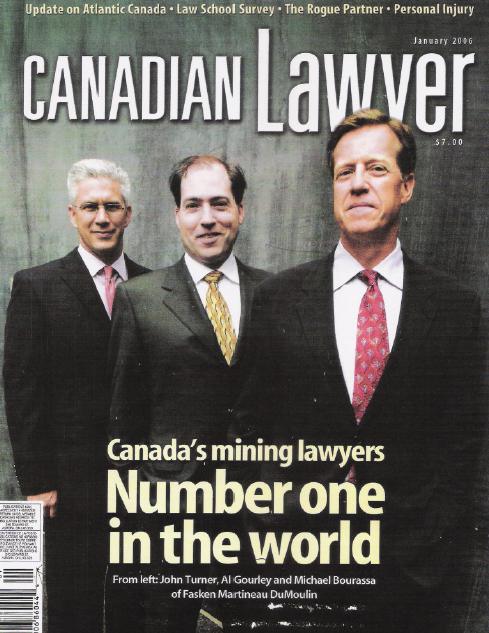
"Blawging" in Canadian Lawyer Magazine

Are blogs by lawyers the "newest thing?"

In the January 2006 edition of Canadian Lawyer Magazine, writer Kevin Marron discusses this phenomenon, and suggests that law bloggers are in fact "changing attitudes about what lawyers can say, and how they can say it."

WISE LAW BLOG received brief mention in Mr. Marron's article, "The Risks and Rewards of 'Blawging,'" which is posted here as a P.D.F.

Finally, as I note that we have officially begun our second year online, let me thank our readers and contributors for their interest and support throughout in this new adventure.

Hopefully, we will continue to find interesting things to write about, and in the process, play at least a small role in making current legal information (as well as our own two cents) accessible online.

Your comments are always appreciated.


- Garry J. Wise, Toronto

Visit our website: www.wiselaw.net

Saturday, March 25, 2006

National Post Profile today

National Post writer Jack Kohane interviewed me last month about some of the things I do after office hours. His very kind article was published in today's Post.

Click to enlarge


-Garry J. Wise, Toronto

Visit our Website: www.wiselaw.net

Saturday, March 18, 2006

$1 Million damages for Mental Suffering to BC Employee


Sulz v. Attorney General of Canada

The British Columbia Supreme Court has awarded Nancy Sulz, a former RCMP officer, damages of nearly $1 million to compensate her for mental suffering arising from her supervisor's workplace misconduct. Ms. Sulz was stationed with the force in Merritt, B.C., a small town of 8,000, located 271 Kilometres (168 miles) northeast of Vancouver.

She was with the force for 12 years, from 1988 to 2000. She left her position with a medical discharge that she had agreed to on the specified condition that it would not interfere with her pending litigation.

By the time Ms. Sulz left the force, an ongoing pattern of harassment, demeaning comments and threats of job-reprisal by her superiors had left Ms. Sulz clinically depressed and medically unable to ever resume her employment with the force.

Examples of alleged demeaning comments included the following statements by her supervisor, a Staff Sergeant Smith:


"Open your eyes and look at the fucking books;"

"If she thinks she's going to sit around on her fat ass and be paid for it, she has another think coming [sic];"

"Get her ass down here and sign these forms"; and

"You want sexual harassment, I'll show you fucking sexual harassment."

The Court awarded Ms. Sulz general damages of $125,000.00, together with compensation for past loss of wages of $225,000.00 and further compensation for loss of future income earning capacity in the sum of $600,000.00.

Total awarded: $950,000.00 plus legal costs.

(Extended portions of the Judgment are excerpted below).

The Sulz decision is an extremely important Judgement, and follows the groundbreaking trend set in the 2005, Ontario Superior Court decision in Keays v. Honda.

In the Keays case, a former Honda Canada worker was awarded two years' salary in lieu of notice plus $500,000 in punitive damages for harassment and discrimination. Mr. Keays, who suffered from chronic fatigue syndrome that emerged in the later years of his 14 year tenure with Honda, was exposed to progressive discipline by his employer for absence due to his illness. Ultimately, his employment was terminated. The Court held that Honda had wrongfully dismissed and discriminated against Mr. Keays. The damages awarded were unprecedented.

We appear to be at the beginning of an era in which employees are increasingly being awarded significant compensatory and punitive damages in cases which involve supervisors' harassment, discrimination and derogatory conduct in the workplace.

This emerging trend clearly should be taken as a wake-up call to employers - employees do have remedies for such misconduct, and the Courts do not take these matters lightly.

- Garry J. Wise, Toronto
Honda case update - March 20, 2006 - Bar-ex reports that Mr. Keays, the Plaintiff in the Honda case, has now also been awarded costs of $610,000, inclusive of disbursements and GST. The matter is scheduled for appeal on April 3, 2006.
- Garry J. Wise, Toronto
......................

Excerpts from the Judgment of The Honourable Mr. Justice Lamperson in Sulz v. Attorney General :

The plaintiff, a former female member of the Royal Canadian Mounted Police ("RCMP"), claims that her immediate supervisors intentionally, or negligently, harassed her to the extent that she became so clinically depressed, she had no choice but to accept a medical discharge.

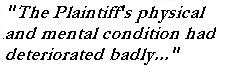
...the plaintiff's physical and mental health had deteriorated badly. She had lost her appetite, was twenty pounds underweight, was unable to sleep properly, and was constantly on the verge of tears. On June 27, she saw her family doctor who advised her to go on sick leave and gave her a note to that effect.

..."I am becoming terrified to come to work, I cannot eat or sleep, I'm on the verge of tears constantly and I'm starting to become convinced it is my fault. I cannot work under these conditions and fear for both my safety as well as my physical and emotional well-being. I am very sorry that this had to come down to this because I feel that I am probably going to be the one to suffer the consequences by being transferred. I do not want to leave Merritt at this point, however, I cannot continue to live and work under these conditions."

...On February 4, 1996, Dr. Carmichael diagnosed the plaintiff as having a major depressive disorder. The plaintiff's weight hovered around 100 lbs. She was not sleeping properly, had difficulty remembering things, and was generally in poor mental and physical health. Dr. Carmichael told the plaintiff to take sick leave, and telephoned the detachment himself to notify her superiors.

...Dr. Carmichael then received an angry phone call from Staff Sergeant Smith, who asked for details of the plaintiff's medical condition, alleged that the plaintiff had manipulated Dr. Carmichael, questioned Dr. Carmichael's ability to do his job, and informed him that the plaintiff might have a drug-dependency problem. The plaintiff believes that Staff Sergeant Smith also reported the drug allegation to RCMP headquarters because headquarters made telephone inquiries with her family doctor, who in turn, notified her.

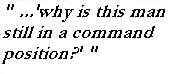
Following that examination, the new divisional representative, Staff Sergeant Howarth, interviewed the plaintiff at her home. On June 24, 1997, Staff Sergeant Howarth sent a report to Chief Superintendent Hrankowski, the officer in charge of administration and personnel for E Division. In his report, Staff Sergeant Howarth acknowledged that his information came from Dr. Carmichael and the plaintiff. He wrote amongst other things: "There is always another side to this BUT if any of this is true, S/Sgt. Smith should not be in the position he is in. I have no reason to doubt Cst. Wilson or Dr. Carmichael." Staff Sergeant Howarth also noted: "Another question that has to be researched is the fact that S/Sgt. Smith may have been investigated for harassment of a female member a few years ago while stationed in the Yukon and the outcome is believed to be founded. If this is true WHY is this man still in a command position?"

The prior episode of harassment to which Staff Sergeant Howarth referred allegedly occurred when the defendant Smith was posted to the Watson Lake detachment between 1986 and 1991.

He was in charge of that detachment and had supervisory authority over Constable Telup, a female First Nations RCMP member. Constable Telup described incidents in which the defendant exhibited intemperate and insensitive behaviour as well as an incident in which he allegedly made improper sexual advances. Constable Telup did not make a complaint at the time, but eventually went on stress leave.

...Inspector Hanniman's detailed report was submitted in evidence before this court. Although it is a slightly edited version, it is Inspector Hanniman's product to which nothing has been added. Based on that report, Chief Superintendent Cameron, the officer in charge of human resources for E Division, notified the plaintiff in writing on September 4, 1998, that the investigation was concluded, that her allegations of harassment had been substantiated, but that no disciplinary action could be taken with respect to Staff Sergeant Smith because he had retired from the RCMP in April 1998.

...Broadly stated, the defendant denied making any derogatory or inappropriate comments about the plaintiff in the presence of detachment personnel. He agreed that the plaintiff's performance as a police officer was of concern and that she was, from time to time, the subject of private discussions between him and Sergeant Angel. Smith denied, however, that these conversations included comments that they would "get her" when she returned to work, that she would pay dearly for her mistakes, that she was screwing the system by taking six months off, or that she had gotten pregnant to screw the force. He admitted discussing the possibility that the plaintiff was afraid of the dark with Sergeant Angel, but says that this was done in private.

... The only explanation that Smith gave when cross-examined about the fact that some of these admitted discussions became common knowledge within the detachment was that the walls in the detachment were very thin.

...However, this evidence must also be considered in context. The RCMP is a paramilitary organization. One of the functions of the supervising non-commissioned officers is to critique the work of their subordinates in an effort to increase their knowledge and skills. The culture in the RCMP was, until comparatively recently, male-oriented, direct, and undiplomatic, while the plaintiff was, on occasion, overly sensitive.

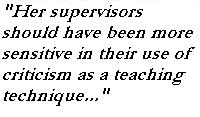
Her supervisors should have been more sensitive in their use of criticism as a teaching technique, and should have dealt with the problem of her repeated absences in a different manner. Although the defendant Smith asserts that he was merely trying to point out to the plaintiff where improvement was needed to assist her in her development as an RCMP officer, the plaintiff cannot be faulted for believing that his comments, like those made in the letter that he had a staff member read over the telephone to her and those contained in the memorandum rejecting her application for a transfer to the highway patrol, went far beyond constructive criticism.

NEGLIGENT INFLICTION OF MENTAL SUFFERING

... A successful claim of negligence must demonstrate that the defendant owed the plaintiff a duty of care, that the defendant breached that duty of care, and that damages or injury resulted from that breach.

The defendant Smith, as the officer in charge of the Merritt detachment and the plaintiff's commanding officer, owed a duty of care to the plaintiff. It was his duty to ensure that she could work in a harassment-free environment, as is required by various anti-harassment policies that the RCMP has in place.

There is no question that Smith breached that duty. The evidence demonstrates that he was prone to angry outbursts, particularly when it pertained to the plaintiff. This was substantiated from a number of sources.... Smith should have known that his intemperate and, at times, unreasonable behaviour would have negative consequences for the members of the detachment generally and the plaintiff in particular.

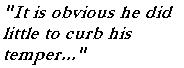
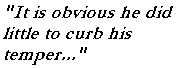
It is obvious that he did little to curb his temper or prevent the rumours that were circulating about the plaintiff, even though he ought to have known, certainly after receiving a copy of the plaintiff's Statement A if not before, that he was causing serious emotional problems for the plaintiff at a time when she was facing significant personal pressures due to her pregnancies. His frequent outbursts and his cutting comments were major causes of the troubled work environment that the plaintiff experienced. It is clear that the defendant Smith violated the RCMP harassment policy, and consequently, breached the standard of care he owed to the plaintiff as a member under his command.

In the circumstances of this case, foreseeability and remoteness are not significant issues. The RCMP established and distributed harassment policies after women were allowed to join the force. All members knew or ought to have known that these policies were meant to forestall harm such as that which occurred here.

Did the defendant's harassment cause or materially contribute to the plaintiff's health problems? The defendants pointed to the fact that the plaintiff had many sources of stress in her life. She had three children within three-and-a-half years.... In other words, defence counsel suggested that it is the plaintiff's personality and the stresses unrelated to her work that is the source of her current problems.

There is merit to this argument. To use a well-known euphemism, the question is whether she had a "thin skull or a crumbling skull?"

There is no doubt that the plaintiff suffers from depression. Dr. Carmichael, in a letter dated August 20, 2003, stated: "Ms. Sulz' s diagnosis according to the DSM-IV criteria has been Major Depressive Disorder, single episode, chronic, with anxiety and irritability features." He went on to say:

Symptoms have included combinations of depressed mood, loss of interest/pleasure in things once enjoyed, low self-esteem, irritability, loss of appetite and weight loss such that at one time hospitalization was considered, significant anxiety, fatigue/loss of energy, strong feelings of guilt, low libido, cognitive impairment (concentration, memory, decision-making), social withdrawal, psychomotor retardation, and persomnia/unrefreshing sleep. Thus, she has not been able to pursue gainful employment since the condition was diagnosed in 1996 due to her condition and its unpredictability. It is clear to me that she can never return to police or related work. 156]

Further on in his letter, Dr. Carmichael states that the "proximal cause of the depression is the long period of work place harassment by the detachment commander at the time, S/Sgt. D. Smith, and by two of his subordinates."

...Although there are many other stresses in the plaintiff''s life, and although she may tend to personalize incidents that others might not, the evidence as a whole shows that the harassment which she experienced in 1994 and 1995 was the proximate cause of her depression, which in turn, ended her career in the RCMP.

The plaintiff has therefore successfully established that the defendant Smith's breach of the duty of care he owed to her caused her serious psychological harm. Although Smith himself is protected from liability for his negligence by s. 21 of the Police Act, the plaintiff has a valid claim for damages against the Provincial Crown based on the principle of vicarious liability.

UPDATE: January, 2007: B.C. Court of Appeal Upholds Sulz $950,000.00 Damages Award

- Garry J. Wise, Toronto

Visit our Employment Law Page: www.wiselaw.net/employment.html

Friday, March 17, 2006

Canadian Spousal Support Advisory Guidelines - Update

I last wrote about the proposed Spousal Support Guidelines in May 2005, to discuss the general features of the new advisory guideline recommendations.

I came across this very interesting summary of how the Courts have been applying the Guidelines in decided cases throughout Canada. As you will note, the Spousal Support Guidelines have had varying degrees of influence, but as at the date of the summary (July 2005), they were increasingly emerging as a starting point for consideration of the quantum and duration of spousal support Orders.

This observation is consistent with our general experience to date in Ontario.

Visit our Family Law Pages: www.wiselaw.net/family.html

Thursday, March 16, 2006

Roll up the Rim and Sue

This today, at CP24 (from my friend Mike Fata)

... In fact, to find the one issue that seems to have transfixed so many, you have to journey down the 401 to Saint-Jerome, Quebec and enter a local Tim Horton’s. That’s where a man who works at a local school bought a coffee, took it with him to work and threw it out in the trash.

It was retrieved by a 10-year-old girl, who asked another student to help her roll up the rim to see if she’d won anything. And as it turns out she had – a Toyota SUV worth almost $30,000. Since then, the drama has deteriorated into an almost embarrassing farce, with three different parties – the man who bought the coffee, the family of the girl who found the cup and the parents of the child who rolled up that rim – all insisting they are the ones who really have claim to the bounty.

Now the lawyer for the coffee buyer is demanding a DNA test to show he’s the real winner – even if he did throw away the winning cup.

The story has become a cause celebre across the country and everyone’s talking about it – when else – during their coffee break. “I think it's only fair to share the prize, I think its unfair not to,” suggests Harry Mohabir as he sips some java at the Eaton Centre. Ida Mancini doesn’t agree. “In all fairness, I think the girl that found the cup, she should keep it,” she insists.

Lawyers, who are the only ones reaping the benefits of the bizarre dispute, admit it’s a tricky area of law. “It's not cut and dried because it is going to depend on a lot of different factors,” contends property lawyer Kelly Moffatt. “The contest sponsors can never really know, no matter how tight their legal rules are, how the contest entrants are gonna respond and what all of those facts are gonna be that are in play.”

In other words, Tim Horton’s is brewing up a lot of publicity without having to do anything. And that’s something money can’t buy. As for settling the dispute, the company notes the person who submits the winning rim is eligible to collect the prize.

But like just about everything els in this twisted case, that decision can be challenged in court. And you can bet given the animosity already shown so far, it probably will be.

Link: http://www.pulse24.com/Business/Top_Story/20060314-002/page.asp


Visit our website: www.wiselaw.net

Tuesday, March 14, 2006

Child Support Guidelines - Changes Ahead in May 2006

On May 1, 2006, the Canadian Child Support Guidelines will be updated with significant amendments.

Among the most important of these changes is that the child support tables have been revised and monthly basic support payments will be increasing.

The amendments will also affect how the Courts determine whether certain kinds of discretionary extraordinary expenses will require contribution by a support payor. In particular, expense claims for primary and secondary education costs and extracurricular activity expenses will be affected. Claims for day-care, medical and post-secondary education costs are not affected by the amendments.

TABLE AMOUNTS TO CHANGE

The monthly "basic support" tables have been updated, and. the required basic support amounts will be increasing as of May 1, 2006.

For example, the monthly child support payable by an Ontario parent of two children will increased as follows:

Income ------New Guidelines------------ Current Guidelines
$50,000 ----------$753.00 -----------------------$700.00
$70,000 ----------$1029.00---------------------- $927.00
$100,000--------- $1404.00--------------------- $1240.00


EXTRAORDINARY EXPENSES - Section 7 of the Guidelines

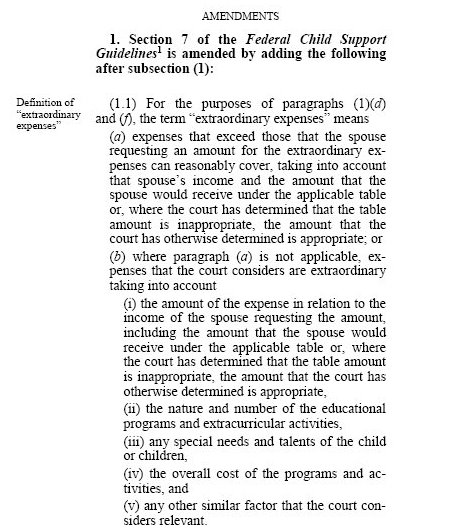
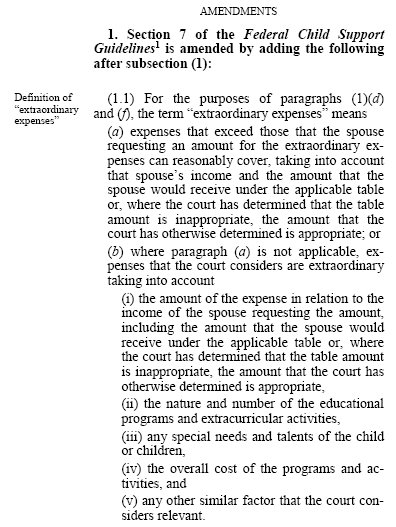
The new version of Section 7 gives Courts much increased flexibility in determining whether certain extraordinary expenses will require additional financial contribution by a support payor.

The new Guidelines will affect claims for contribution by a payor to extraordinary expenses for:


  • primary or secondary school education or for any other educational programs that meet the child's particular needs, and
  • extraordinary expenses for extracurricular activities.
A custodial parent requesting such contribution must demonstrate that the requested extraordinary expense cannot reasonably be covered by the basic support payable.

This "reasonable coverage" requirement may well impose a new threshold or test for determining whether additional contribution to an expense is required.

At the very least, the Courts are to be given a widened discretion by this amendment.

While this may be seen as codifying a discretion that has to some extent already been exercised, it does open up a significant statutory front for resistance by payors to claims for contribution toward the specified extraordinary expenses.

The new Section 7 is reproduced below:


These amendments do not affect the requirement of contribution for day care and child care expenses, medical and dental expenses, or the costs of post secondary education. These expenses will continue to be assessed, taking into account:
  • the necessity of the expense in relation to the child's best interests
  • the reasonableness of the expense in relation to the means of the spouses and those of the child, and
  • the family's spending pattern prior to the separation.
For a full text of the new Guideline tables and amendments, see:
http://canadagazette.gc.ca/partII/2005/20051214/pdf/g2-13925.pdf#page=356


- Garry J. Wise, Toronto
Visit our Ontario Family Law Pages at: www.wiselaw.net/family.html

Wednesday, January 11, 2006

Moon over Maryland


Another silly case...

(Slightly edited from the original report in the Detroit News:)

A Maryland judge has ruled that mooning is a cheeky yet legitimate form of communication. "With hard work, we cracked the case, no buts about it," lawyer James Maxwell said of his legal victory last week.

Last June, exasperated by a feud involving a homeowners association, Raymond McNealy, 44, of Germantown, Md. felt moved to moon his neighbor Nanette Vonfeldt, a Member of the association's board, who was accompanied by her 8-year-old daughter.

McNealy was tried for indecent exposure and found guilty last fall. His Misbegotten moon could have cost him three years in prison and a $1,000 fine.

After an automatic appeal, last week the verdict was reversed.

In ruling that buttocks are never "private parts" to fit the crime of indecent exposure, Circuit Court Judge John Debelius III said, "If exposure of half of the buttock constituted indecent exposure, any woman wearing a thong at the beach at Ocean City would be guilty."


- Garry J. Wise
Visit our Website - www.wiselaw.net

Unborn Baby not a Person - Arizona Car Pool Judge


See this ABC News story on breaking developments in Phoenix, Arizona traffic law.

A very pregnant woman, after being stopped by the police for driving alone in a carpool lane limited to vehicles with more than one passenger, pointed to her very expectant stomach and said something like... "But officer, there are two of us...."

On Tuesday, an Arizona judge ruled that fetuses should not be considered passengers in HOV lanes. On Nov. 8, Ahwatukee, Ariz., resident Candace Dickinson, who was nine months pregnant and driving alone, hoped to break out of Phoenix's heavy rush-hour traffic and moved into an HOV lane. Police pulled her over and wrote a ticket.

Dickinson, 23, fought the ticket, saying that her then-unborn child was her other occupant. She appeared in court Tuesday to state her case, but Municipal Court Judge Dennis Freeman rejected her argument.

The mom-to-be was found guilty and fined $367.00.

One can only hope this case will not attract the attention of Ralph Reed and the pro-Life movement.


- Garry J. Wise


Visit our Website - www.wiselaw.net

Thursday, December 08, 2005

Louise Arbour on Torture - A Distinguished Canadian Voice Takes American Heat

Former Supreme Court of Canada Justice Louise Arbour has served at the United Nations as High Commissioner for Human Rights since 2004. She is internationally regarded for her previous role as chief prosecutor for tribunals into the genocide in Rwanda and human rights abuses in Yugoslavia in the 1990s.

(I should also note that Madame Arbour was my Criminal Procedure professor at Osgoode Hall Law School in the early 1980's)

According to its website, "The Office of the High Commissioner for Human Rights (OHCHR) is a department of the United Nations Secretariat. It is mandated to promote and protect the enjoyment and full realization, by all people, of all rights established in the Charter of the United Nations and in international human rights laws and treaties. The mandate includes preventing human rights violations, securing respect for all human rights, promoting international cooperation to protect human rights, coordinating related activities throughout the United Nations, and strengthening and streamlining the United Nations system in the field of human rights."

Given her unassailable background and the dire seriousness of her current mandate, my eyebrow was raised by today's BBC report as to the diplomatic backlash from America's controversial UN Amassador, John Bolton, which has followed Justice Arbour's recent comments, condemning the reported U.S. policy of rendition of terror suspects to secret, foreign jails for "questioning:"


US attacks UN official on 'jails'

Washington has rebuked UN human rights commissioner Louise Arbour for criticising its anti-terror tactics as the alleged secret jails row goes on.

Ms Arbour said reports the US was using secret overseas sites to interrogate suspects harmed its moral authority and she wanted to inspect any such centres.

The US said it was inappropriate and illegitimate for her to question US conduct on the basis of media reports.

The issue is dogging a European tour by US Secretary of State Condoleezza Rice.

She will meet Nato foreign ministers on Thursday for formal talks but at a dinner on Wednesday the jails allegation reportedly already surfaced.

"There were a number of frank interventions, always respectful of Condoleezza Rice as a person," a source briefed on the dinner was quoted by Reuters news agency as saying.

On Wednesday, Ms Rice said American interrogators were bound by an international convention banning the use of torture, regardless of whether they were working in the US or abroad. "Second-guessing' Ms Arbour, a former Canadian Supreme Court justice, told reporters in New York on Wednesday that the global ban on torture was becoming a casualty of the US-led "war on terror".

She singled out the reported US policies of sending terror suspects to other countries and holding prisoners in secret detention.

"Two phenomena today are having an acutely corrosive effect on the global ban on torture and cruel, inhuman or degrading treatment," she said.

"There are lots of human rights that can be set aside temporarily in cases of emergencies, lots of them, but not the right to life and not the protection against torture," she added.

The UN human rights commissioner said the theme of Saturday's annual commemoration of the UN's adoption of the Universal Declaration of Human Rights in 1948 would be "terrorists and torturers".

She added that the US had played an important leadership role in civil and political rights but that there was now a perception they had withdrawn from the commitment to such liberties, which made it harder for the US to exercise moral leadership.

America's ambassador to the UN, John Bolton, said Ms Rice had already addressed the issue and he roundly criticised Ms Arbour. It was, he said, "inappropriate and illegitimate for an international civil servant to second-guess the conduct that we're engaged in [in] the war on terror, with nothing more as evidence than what she reads in the newspapers".

- Garry J. Wise

Visit our website www.wiselaw.net

Thursday, November 10, 2005

Child Support in Canada - "Days do Not Equal Dollars"

Leonelli-Contino and Contino

The Supreme Court of Canada today issued an important ruling on the application of the "40% Rule," as set out in Section 9 of the Federal Child Support Guidelines. This provision requires the Courts to consider a number of factors in establishing child support requirements where custody of children is shared, and a child resides with the support payor at least 40% of the time.

Where residency time is less than 40%, the Guidelines provide that specified table amounts are payable, based solely on the payor's income, the province of the children's primary residence and the number of children in the family.

Many support payors, noting the increased costs of providing for such residency, have argued that their support should automatically be reduced if a child resides with them for 40% or more of the time. This has led to some interesting questions including how the 40% should be calculated - does it include sleep time or daytime when a child is at school and not in either parent's direct care?

The Court's ruling clarifies the approach to be taken in determining support requirements in shared custody cases.

The Court held that no automatic reduction of support flows from reaching the 40% threshold - rather, all financial circumstances of the family are to be taken into account by a Court bearing in mind the aim of the Guidelines to provide appropriate resources and an adequate living standard for children in each of their parents' homes.


See the excerpt below from CTV News:


CTV.ca News Staff

The Supreme Court of Canada has decided that 'days do not equal dollars' when it comes to child support.

In an 8-1 majority decision, the court decided that a divorced parent who spends more time with his or her children should not necessarily be able to automatically pay less child support.

The case involved two Ontario parents, Joseph Contino and Joanne Leonelli-Contino. They were married in 1982, had one son in 1986, separated in 1989 and were divorced in 1993. Under their separation agreement, the parents took joint custody of their son, Christopher. The boy lived primarily with Leonelli-Contino while the boy's father had access to him on alternate weekends and Thursday nights.

In 2000, when Contino's access was increased by more nights per month to accommodate his former wife's studies, an Ontario Family Court judge ruled Contino's child care payments should be reduced.

The judge decided the payments should be cut on the basis that Contino was caring for his son almost half the time.

That was later adjusted by further court decisions over the next five years, with Contino at one point paying a high of $688 a month and a low of $100 a month. Joanne disagreed with the decisions and took the case to the Supreme Court.

On Thursday, the Supreme Court decided that the family's entire financial context should be taken into account to ensure an adequate standard of living for both parental homes. "It is important to keep in mind the objectives of the [Federal Child Support] Guidelines, requiring a fair standard of support for the child and fair contributions from both parents," Justice Michel Bastarache wrote for the majority.

"Any attempt to apply strict formulae will fail to recognize the reality of various families.''

They decided a more reasonable support payment amount would be $500 a month.
Leonelli-Contino's lawyer, Deidre Smith, told Canada AM ahead of the decision that her client's position was that extra time with a child in itself should not be a reason to reduce support payments.

"If there had been a change in expenses, if he had assumed a larger portion of the child's hockey expenses or if he was now having to go out and get a bigger home to accommodate his child because his child was now spending more time, if he was doing more of the transportation, paying more of the school expenses -- then those types of things would make sense as to why there would be a change in the support arrangements," she explained.

"But in our thinking, time in and of itself shouldn't be a reason to change around the finances."

Smith said she was worried that if the courts decided that "days equal dollars," some parents would try to exploit the idea simply to reduce their payments.

"Moms are going to be suspicious if Dad is asking for extra time and the only reason he's asking for it is to reduce his support," she noted. She worried that that kind of thinking would not take into account about that amount of parenting would be best for the child.

Following the decision, Smith said she hopes the decision will help clarify the sometimes confusing Federal Child Support Guidelines. "It's an important case because it helps Canadians understand how to interpret the child-support guidelines," she said. "This issue has been bedevilling Canadians, judges and lawyers . . . across the country.

- Garry J. Wise, Toronto

Visit our website: www.wiselaw.net/family.html

Friday, September 02, 2005

Where Were the Buses?

In the immediate wake of the crisis that has been unfolding this week in the "Big Easy," focus needs to remain on helping the victims. Canadians can donate to the Canadian Red Cross online or by telephone at 1-800-418-1111. All major Banks will also be accepting donations as of September 6th.

Nonetheless, I'm still trying to figure out why those same convoys of buses, sent to rescue thousands of stranded refugees after Katrina, weren't dispatched before this deluge to stop this human tragedy, before it ever started.

It's not like we didn't have a pretty good idea of what was coming. Even CNN was onto that.

An estimated 1 million people evacuated New Orleans and surrounding areas as Hurricane Katrina approached the Gulf Coast Sunday. New Orleans Mayor Ray Nagin said 75 percent to 80 percent of residents had been evacuated by Sunday evening. Some 30,000 people were taken to the Louisiana Superdome, reported CNN.

"We are in lockdown mode now," Nagin said on WWL-AM.

Walter S. Maestri, director of the Jefferson Parish Department of Emergency Management, estimated 1 million people had been evacuated. Approximately 1.3 million people live in the New Orleans metro area.

On Sunday evening, the hurricane was about 130 miles south of the mouth of the Mississippi River and expected to hit land early Monday. Conditions were already beginning to deteriorate along portions of the central and northeastern Gulf Coast.

Max Mayfield, director of the National Hurricane Center, told CNN Katrina is the strongest hurricane he has ever seen. "Not just because of the intensity but the size of this and the area that it`s hitting," he said.

Mayfield said there is a lot of attention on the threat Katrina poses to New Orleans, but western Mississippi is also going to get hit hard. New Orleans lies below sea level, separated from the Mississippi by huge levees.

I'll have more to say about Katrina in future days. But to give you an idea where I am heading, read a bit of this from Alan Eisner of Reuters News:

Virtually everything that has happened in New Orleans since Hurricane Katrina struck was predicted by experts and in computer models, so emergency management specialists wonder why authorities were so unprepared.

"The scenario of a major hurricane hitting New Orleans was well anticipated, predicted and drilled around," said Clare Rubin, an emergency management consultant who also teaches at the Institute for Crisis, Disaster, and Risk Management at George Washington University.

Computer models developed at Louisiana State University and other institutions made detailed projections of what would happen if water flowed over the levees protecting the city or if they failed.

In July 2004, more than 40 federal, state, local and volunteer organizations practiced this very scenario in a five-day simulation code-named "Hurricane Pam," where they had to deal with an imaginary storm that destroyed over half a million buildings in New Orleans and forced the evacuation of a million residents.

At the end of the exercise Ron Castleman, regional director for the Federal Emergency Management Agency declared, "We made great progress this week in our preparedness efforts.

"Disaster response teams developed action plans in critical areas such as search and rescue, medical care, sheltering, temporary housing, school restoration and debris management. These plans are essential for quick response to a hurricane but will also help in other emergencies," he said.

In light of that, said disaster expert Bill Waugh of Georgia State University, "It's inexplicable how unprepared for the flooding they were." He said a slow decline over several years in funding for emergency management was partly to blame.

In comments on Thursday, President George W. Bush' said, "I don't think anybody anticipated the breach of the levees."

But Louisiana State University engineer Joseph Suhayda and others have warned for years that defenses could fail. In 2002, the New Orleans Times Picayune published a five-part series on "The Big One" examining what might happen if they did.

Also on my mind is this hard-hitting story, posted August 31, 2005, at Editor And Publisher:

Even though Hurricane Katrina has moved well north of the city, the waters may still keep rising in New Orleans. That's because Lake Pontchartrain continues to pour through a two-block-long break in the main levee, near the city's 17th Street Canal.

With much of the Crescent City some 10 feet below sea level, the rising tide may not stop until it's level with the massive lake.New Orleans had long known it was highly vulnerable to flooding and a direct hit from a hurricane.

In fact, the federal government has been working with state and local officials in the region since the late 1960s on major hurricane and flood relief efforts. When flooding from a massive rainstorm in May 1995 killed six people, Congress authorized the Southeast Louisiana Urban Flood Control Project, or SELA.

Over the next 10 years, the Army Corps of Engineers, tasked with carrying out SELA, spent $430 million on shoring up levees and building pumping stations, with $50 million in local aid. But at least $250 million in crucial projects remained, even as hurricane activity in the Atlantic Basin increased dramatically and the levees surrounding New Orleans continued to subside. Yet after 2003, the flow of federal dollars toward SELA dropped to a trickle.

The Corps never tried to hide the fact that the spending pressures of the war in Iraq, as well as homeland security -- coming at the same time as federal tax cuts -- was the reason for the strain.

At least nine articles in the Times-Picayune from 2004 and 2005 specifically cite the cost of Iraq as a reason for the lack of hurricane- and flood-control dollars.

Newhouse News Service, in an article posted late Tuesday night at The Times-Picayune Web site, reported: "No one can say they didn't see it coming. ... Now in the wake of one of the worst storms ever, serious questions are being asked about the lack of preparation."

In early 2004, as the cost of the conflict in Iraq soared, President Bush proposed spending less than 20 percent of what the Corps said was needed for Lake Pontchartrain, according to a Feb. 16, 2004, article, in New Orleans CityBusiness.

On June 8, 2004, Walter Maestri, emergency management chief for Jefferson Parish, Louisiana; told the Times-Picayune: "It appears that the money has been moved in the president's budget to handle homeland security and the war in Iraq, and I suppose that's the price we pay. Nobody locally is happy that the levees can't be finished, and we are doing everything we can to make the case that this is a security issue for us."

Also that June, with the 2004 hurricane season starting, the Corps' project manager Al Naomi went before a local agency, the East Jefferson Levee Authority, and essentially begged for $2 million for urgent work that Washington was now unable to pay for. From the June 18, 2004 Times-Picayune:

"The system is in great shape, but the levees are sinking. Everything is sinking, and if we don't get the money fast enough to raise them, then we can't stay ahead of the settlement," he said. "The problem that we have isn't that the levee is low, but that the federal funds have dried up so that we can't raise them."

Garry J. Wise

Visit our Website: www.wiselaw.net


Thursday, September 01, 2005

B.C. Supreme Court tosses traditional definition of adultery

In this new era of same-sex marriage and same-sex divorce, Canadian family law is, of necessity, undergoing a fudamental re-thinking.

The case below, excerpted from CTV.ca, highlights just one of many new challenges to our most basic (but now, patently anachronistic) family law principles.

In short, the traditiional definition of adultery, as extra-marital sexual relations between a spouse and a person of the opposite sex, is no longer applicable (in B.C., anyways). No doubt, courts in Ontario and the rest of the country will follow.

(We'll be arguing this same issue in a same-sex divorce proceeding in Toronto shortly. We'll keep you posted):

A B.C. Supreme Court judge granted a Vancouver woman a divorce Tuesday after deciding that the woman's husband had indeed engaged in adultery when he had sex with another man. The traditional definition of adultery is voluntary sex between a spouse and someone of the opposite gender, to whom he or she isn't married.

But Justice Nicole Garson of the B.C. Supreme Court said Tuesday that she had been persuaded to make a change in the traditional definition of adultery. The woman, who can be identified only as Ms. P due to a court order, was challenging Canada's divorce legislation after Garson earlier ruled that her husband's extramarital affair with a man didn't legally count as adultery.

The woman had been married nearly 17 years when, last October, she discovered her husband was having an affair with a younger man. She and her husband separated immediately and she filed for divorce two months later, seeking an immediate end to their marriage. Her husband signed an affidavit on Jan. 5, 2005, acknowledging his adulterous relationship, and didn't appear in court in February to contest the divorce.

Canada's Divorce Act allows for a no-fault divorce after a one-year separation, on grounds of marital breakdown. It also allows for an immediate divorce if there is admitted or proven adultery or cruelty. But Garson refused to grant an immediate divorce -- because the definition of adultery in common law didn't include homosexual relations.

"I was completely devastated and I felt like I didn't matter," Ms. P told CTV's Canada AM. The judge told the woman last Friday that she would hear the case again if a lawyer could argue why the legal definition of adultery should be broadened to include same-sex adultery. The woman's lawyer, barbara findlay (who spells her name in lower-case letters), argued that the traditional definition of adultery is as outdated as the original common-law definition of marriage, which was based on procreation.

"We argued, and the federal government agreed with us, that the court can make what is called in law an incremental change in light of current circumstances," said findlay, "so that divorce will, from now on, be understood to be available where there is, for example, intimate genital contact between two people, one of whom is married."

Garson's decision is expected to have far-reaching consequences across Canada, said findlay, because of the increasing number of same-sex marriages that will inevitably lead to same-sex affairs. She added that, because adultery isn't defined through federal legislation, judges hearing similar cases in other provinces will likely be persuaded by the B.C. judge's decision. "I would expect that other judges faced with the same question would rule in the same way," findlay told CTV....

The woman has also launched a constitutional challenge based on the Charter, saying the definition of adultery discriminates against gay and lesbian couples because it makes divorce less accessible to them compared to homosexuals.

- Garry J. Wise, Toronto

Visit our website: www.wiselaw.net/family.html