Sunday, October 15, 2006

Habeus Corpus


Keith Olbermann of MSNBC comments on the potentially detrimental impact of recent U.S. legislation on the traditional, constitutional entitlement to habeus corpus in America.

(This legislation, the Military Commission’s Act of 2006, represents Congress' response to the U.S. Supreme Court's decision in Hamdan v. Rumsfeld, on which I commented here.)

For a short primer on habeus in Canada, see the excerpt below, from Canadiana.org:

Habeas corpus: A writ or order requiring that prisoners be brought before a court to determine if he or she is being held lawfully. [sic]

The right of habeas corpus is intended to prevent imprisonment without charges.

The right of habeas corpus has been suspended several times in Canadian history, most notably when German, Ukrainian and other Slavic Canadians were interned in World War I, and when Japanese Canadians were interned during World War II. It was also suspended in Québec in 1970 during the October Crisis.

Highly related is the issuance of Canadian Security Certificates under the Immigration and Refugee Protection Act. This legislation provides for the removal, without open hearing, of any non-citizen who is found to pose a security threat to Canada:

DIVISION 9 - PROTECTION OF INFORMATION

Examination on Request by the Minister and the Minister of Public Safety and Emergency Preparedness

Referral of certificate
77. (1) The Minister and the Minister of Public Safety and Emergency Preparedness shall sign a certificate stating that a permanent resident or a foreign national is inadmissible on grounds of security, violating human or international rights, serious criminality or organized criminality and refer it to the Federal Court, which shall make a determination under section 80.

Effect of referral
(2) When the certificate is referred, a proceeding under this Act respecting the person named in the certificate, other than an application under subsection 112(1), may not be commenced and, if commenced, must be adjourned, until the judge makes the determination. 2001, c. 27, s. 77; 2002, c. 8, s. 194; 2005, c. 10, s. 34.

Judicial consideration
78. The following provisions govern the determination:

(a) the judge shall hear the matter;

(b) the judge shall ensure the confidentiality of the information on which the certificate is based and of any other evidence that may be provided to the judge if, in the opinion of the judge, its disclosure would be injurious to national security or to the safety of any person;

(c) the judge shall deal with all matters as informally and expeditiously as the circumstances and considerations of fairness and natural justice permit;

(d) the judge shall examine the information and any other evidence in private within seven days after the referral of the certificate for determination;

(e) on each request of the Minister or the Minister of Public Safety and Emergency Preparedness made at any time during the proceedings, the judge shall hear all or part of the information or evidence in the absence of the permanent resident or the foreign national named in the certificate and their counsel if, in the opinion of the judge, its disclosure would be injurious to national security or to the safety of any person;

(f) the information or evidence described in paragraph ( e) shall be returned to the Minister and the Minister of Public Safety and Emergency Preparedness and shall not be considered by the judge in deciding whether the certificate is reasonable if either the matter is withdrawn or if the judge determines that the information or evidence is not relevant or, if it is relevant, that it should be part of the summary;

(g) the information or evidence described in paragraph (e) shall not be included in the summary but may be considered by the judge in deciding whether the certificate is reasonable if the judge determines that the information or evidence is relevant but that its disclosure would be injurious to national security or to the safety of any person;

(h) the judge shall provide the permanent resident or the foreign national with a summary of the information or evidence that enables them to be reasonably informed of the circumstances giving rise to the certificate, but that does not include anything that in the opinion of the judge would be injurious to national security or to the safety of any person if disclosed;

(i) the judge shall provide the permanent resident or the foreign national with an opportunity to be heard regarding their inadmissibility; and

(j) the judge may receive into evidence anything that, in the opinion of the judge, is appropriate, even if it is inadmissible in a court of law, and may base the decision on that evidence. 2001, c. 27, s. 78; 2005, c. 10, s. 34(E).

Proceedings suspended
79. (1) On the request of the Minister, the permanent resident or the foreign national, a judge shall suspend a proceeding with respect to a certificate in order for the Minister to decide an application for protection made under subsection 112(1).

Proceedings resumed
(2) If a proceeding is suspended under subsection (1) and the application for protection is decided, the Minister shall give notice of the decision to the permanent resident or the foreign national and to the judge, the judge shall resume the proceeding and the judge shall review the lawfulness of the decision of the Minister, taking into account the grounds referred to in subsection 18.1(4) of the Federal Courts Act. 2001, c. 27, s. 79; 2002, c. 8, s. 194.

Determination that certificate is reasonable
80. (1) The judge shall, on the basis of the information and evidence available, determine whether the certificate is reasonable and whether the decision on the application for protection, if any, is lawfully made.

Determination that certificate is not reasonable
(2) The judge shall quash a certificate if the judge is of the opinion that it is not reasonable. If the judge does not quash the certificate but determines that the decision on the application for protection is not lawfully made, the judge shall quash the decision and suspend the proceeding to allow the Minister to make a decision on the application for protection.

Determination not reviewable
(3) The determination of the judge is final and may not be appealed or judicially reviewed.

Effect of determination — removal order
81. If a certificate is determined to be reasonable under subsection 80(1),

(a) it is conclusive proof that the permanent resident or the foreign national named in it is inadmissible;

(b) it is a removal order that may not be appealed against and that is in force without the necessity of holding or continuing an examination or an admissibility hearing; and

(c) the person named in it may not apply for protection under subsection 112(1).
The constitutionality of Security Certificate procedures was reviewed by the Supreme Court of Canada in June 2006. The Court's decision is now pending.
CTV News had this backgrounder (excerpted below) on Security Certficates in the context of the S.C.C. case:

Three men are being detained in Canada with little information why, or even when they may be released. Some have been locked away for years. All are legally held using national security certificates.

The government argues the certificates are crucial to protecting Canadians from potential terrorists who have come into the country. Critics say they're an affront to the Charter of Rights and Freedoms...

... The judge's decision is made in private, without the presence of the person named in the certificate or any legal counsel. The person named in the certificate only receives a summary of the information that "enables them to be reasonably informed of the circumstances giving rise to the certificate."

... these summaries are brief sketches at best, giving little indication why an individual is being held. He or she is then allowed to present their case in open court and argue why they are not a threat and should not be deported.

When a judge does make a ruling, the person cannot appeal it. If the judge agrees with the certificate, the person is removed from the country. If not, the certificate is rejected and the person is released.
-Garry J. Wise, Toronto
Visit our Website: www.wiselaw.net

Saturday, October 14, 2006

The Children's Wish "Wishmaker" Parade

Children's Wish is a truly worthy Canadian charity.

Today, in more than 100 communities across Canada, the Children's Wish "Wishmaker Parade" is raising funds to grant wishes for children diagnosed with high risk, life-threatening illnesses.

Wise, Kirsh and Winberg (that's my band, not a law firm!) joined Toronto Mayor David Miller and various other local personalities and performers for a benefit concert at Sunnybrook Park this morning, preceding the parade.

The Children’s Wish Foundation of Canada is dedicated to working within the community to help every child enjoy the best quality of life possible, including the experience of laughter, shared joy and treasured memories with important people in their lives.

The Toronto Wishmaker Parade had an excellent turnout, in spite of weather challenges (although we were lucky enough to have the sun mostly shining when we took the stage). For those interested, our setlist included a cover of CSNY's Teach Your Children and five original songs: Northland Summer, Casting Colours, Together, Wayward Son and Open Up Your Eyes.

Congratulations to the Toronto organizers of this successful day, and a special word of thanks to Paul Lawrence who asked us to be a part of this excellent event.

-Garry J. Wise, Toronto
Visit our Website www.wiselaw.net

Friday, September 29, 2006

Crosby, Stills, Nash, Young and Springsteen

As a bit of a change of pace from our usual legal updates, it is worth noting that YouTube has become a veritable goldmine for archived and rare concert footage.

If you know anything about where my musical tastes are rooted, you will understand why this video pretty much had to be posted on the Blog.

I think almost every performer I've ever listened to more than once is on this stage (plus Robin Williams)....

If you ever have a bit of time to kill, go to YouTube.com and search out your favourite performers.

You may find yourself glued to the screen for quite a while.


-Garry J. Wise, Toronto
Visit our Website: www.wiselaw.net

Friday, August 25, 2006

Cameras coming soon to Ontario Courtrooms?

This report from CityNews:

A panel of experts studying access to justice is suggesting that cameras be allowed in some Ontario courtrooms. They believe the time has come for residents of the province to see how the wheels of justice grind, and are recommending the unblinking eye be let into the Court of Appeal and Divisional Court, as well as the Superior Court and the Ontario Court of Justice as long as no witnesses are examined.

Cameras are currently banned in all Ontario courts.

But Attorney General Michael Bryant is prepared to seriously consider the idea.

"I agree with the recommendation," he agrees. "I think it is inevitable that cameras will be coming into the courtrooms of our nation, and I think that our justice system is ready for its close-up."


- Garry J. Wise, Toronto

Visit our Website: www.wiselaw.net

Wednesday, August 02, 2006

Supreme Court of Canada to Child Support Payors: Income Increases Must be Disclosed

The Supreme Court of Canada decided yesterday in D.B.S and S.R.G. et al that child support payors who do not make timely disclosure of income increases are liable to pay increased child support retroactively under the Child Support Guidelines, once the income increases come to light.

CTV News Reports on yesterday's Supreme Court of Canada ruling:

Canada's Supreme Court has ruled ex-spouses could face hefty retroactive child support payments if they fail to declare increased earnings -- a decision that could affect thousands of divorced and separated couples across the country.

The ruling was unanimous: 7-0. The top court decided that ex-spouses -- the fathers in most cases -- who pay support have an obligation to report increases in income which could therefore boost their court-ordered payments.

"Parents have an obligation to support their children in a way that is commensurate with their income," said Justice Michel Bastarache, writing the main opinion.

"A payor parent who does not increase his-her child support payments to correspond with his-her income will not have fulfilled his-her obligation to his-her children."

The court also ruled that former spouses should be hit with retroactive penalties if they fail to inform their ex-partner about any changes to their income. The rough guideline is that penalties should not stretch back more than three years, said Bastarache.

The court left the door open for lower courts to decide on those payments on a case-by-case basis.

I'm posting this from vacation in Newfoundland, so I'll have to leave extended commentary on the Supreme Court's decision in DBS and SRG to a later date.

In short, however, this decision is not even slightly surprising. I frankly am surprised it has made national headlines.

The Guidelines are quite clear. Support is based on a payor's actual income - not on what the recipient may believe the payor's income to be.

Did anyone really expect the Court to reward payors who intentionally withhold relevant information that their incomes have increased?


- Garry J. Wise, near Gros Morne National Park, Newfoundland
Visit our website: www.wiselaw.net/family.html

Friday, June 30, 2006

Bush Rebuked: US Supreme Court says 'No Texas Justice' for Guantanamo Detainees

In an major decision yesterday, the U.S. Supreme Court struck down the Bush administration's plan to conduct trials of accused Guantanamo Bay prisoners utilizing military tribunals.

The Court held that the President's plan exceeded his constitutional authority, even in wartime, and further found that the proposed tribunals failed to provide even minimum legal protections, in violation of International Law and the Geneva Conventions

The decision has wide political and legal implications, and may well bring into question the legality of other controversial Bush administration measures, including a programme of domestic wiretapping in the absence of Court oversight.

This report, excerpted from Yahoo News summarizes the Court's decision:

Supreme Court blocks Guantanamo trials

GINA HOLLAND, Associated Press Writer

WASHINGTON - The Supreme Court rebuked President Bush and his anti-terror policies Thursday, ruling that his plan to try Guantanamo Bay detainees in military tribunals violates U.S. and international law.

The court declared 5-3 that the president's attempt to resurrect a type of military trial last used in the aftermath of World War II violates U.S. military law and the Geneva conventions that set international standards for dealing with people captured in armed conflicts.

The ruling focused on Salim Ahmed Hamdan, a one-time driver for Osama bin Laden who has spent four years in the U.S. prison at Guantanamo Bay, Cuba. He faces a single count of conspiring to commit terrorism...

The decision could have a broad impact on the administration's legal justification for many of its policies in the global fight against terrorism, from eavesdropping to detention policies in Iraq...

The majority found that Congress had not given Bush the authority to create the special type of military trial and that the president did not provide a valid reason for the new system. The justices also said the proposed trials did not provide for minimum legal protections under international law...

While the administration could come up with a new system, a better option would be to hold regular military courts-martial for detainees, the high court said. Those trials, used for soldiers, provide somewhat similar legal protections to those that defendants receive in U.S. courts.

The Bush administration did not appear ready to accept that...


In "The significance of Hamdan v. Rumsfeld," Glenn Greenwald, a New York constitutional lawyer and commentator, offers the seminal legal analysis of this decision:

The Supreme Court today, by a 5-3 decision (.pdf) in Hamdan v. Rumsfeld, held that the Bush administration's military commissions at Guantanamo (a) exceed the president's legal authorization given by Congress and (b) violate the law of war, including Common Article 3 of the Geneva Conventions which, the Court held, applies to all detainees in any armed conflict, including Al Qaeda members.

This is a very significant legal defeat, in several ways, for the administration. Following are preliminary observations about this decision:

(1) The Supreme Court held [Sec. VI(D)(ii) of the court's opinion] that Common Article 3 of the Geneva Conventions applies to all detainees captured in military conflicts, including Al Qaeda members or other "enemy combatants," and not merely (as the Administration asserted) to soldiers who fight for established countries which are signatories to the Conventions. Article 3 requires that detainees be tried by a "regularly constituted court affording all the judicial guarantees which are recognized as indispensable by civilized peoples," and the Court ruled [Sec. VI(D)(iii)] that the military commissions established at Guantanamo violate that requirement because they are not regularly constituted tribunals but instead are specially constituted courts in the absence of any emergency. Thus, under the Geneva Conventions, any and all detainees captured in armed conflict can be tried only by a "regularly constituted court affording all the judicial guarantees which are recognized as indispensable by civilized peoples."

(2) The Court did not rule on whether it could, in the absence of Congressional mandates, compel the administration to abide by the Geneva Conventions. The Court did not need to rule on this question, because it found [Sec. IV] that the administration was required by Congress -- as part of the Uniform Code of Military Justice ("UCMJ") -- to comply with the rules of law when creating and implementing military commissions. Thus, the Court enforced the Congressional statutory requirement that the administration comply with the rules of law with regard to all military commissions, and rejected any claims by the administration to possess authority to override or act in violation of that statute.

(3) The Court dealt several substantial blows to the administration's theories of executive power beyond the military commission context. And, at the very least, the Court severely weakened, if not outright precluded, the administration's legal defenses with regard to its violations of FISA.

... More broadly, the Supreme Court repeatedly emphasized the shared powers which Congress and the Executive possess with regard to war matters. Indeed, in his concurring opinion, Justice Kennedy expressly applied the mandates of Justice Jackson's framework in Youngstown (the Steel Seizure case) on the ground that this was a case where the adminstration's conduct (in creating military commissions) conflicted with Congressional statute (which requires such commissions to comply with the law of war). Applying Youngstown, Kennedy concluded that the President's powers in such a case are at their "lowest ebb" and must give way to Congressional law. In other words, Kennedy expressly found (and the Court itself implicitly held) that even with regard to matters as central to national security as the detention and trial of Al Qaeda members, the President does not have the power to ignore or violate Congressional law...

(4) This decision illustrates just how critical is the current composition of the Supreme Court. The decision was really 5-4 (because Roberts already ruled in favor of the administration in the lower court). The Justice who wrote the majority opinion, John Paul Stevens, is 86 years old, and as Justice Blackmun once famously warned, he "cannot remain on this Court forever." If the Bush administration is permitted to replace Stevens with yet another worshipper of executive power, the next challenge to the Bush administration's theories of unchecked power could very easily result, by a 5-4 vote, in the opposite outcome.

(5) Congress can reverse almost every aspect of the decision as it specifically pertains to these military commissions. It could abrogate any treaties it wants. It could amend the UCMJ to allow military commissions with the rules established by the President. It has already stripped the Court of jurisdiction to hear future habeas corpus challenges by Guantanamo detainees, and could act to further strip the Court of jurisdiction in these areas. We will undoubtedly hear calls by Pat Roberts, John Cornyn, Jeff Sessions, Tom Coburn (and perhaps Joe Lieberman?) et al. for legislation which would accomplish exactly that.

Nonetheless, opponents of monarchical power should celebrate this decision. It has been some time since real limits were placed on the Bush administration in the area of national security. The rejection of the President's claims to unlimited authority with regard to how Al Qaeda prisoners are treated is extraordinary and encouraging by any measure. The decision is an important step towards re-establishing the principle that there are three co-equal branches of government and that the threat of terrorism does not justify radical departures from the principles of government on which our country was founded.

... The more I read and think about this opinion, the greater a death blow I think it deals -- at least on the legal front -- to the administration's Yoo theory of unlimited executive power. ... "Whether or not the President has independent power, absent congressional authorization, to convene military commissions, he may not disregard limitations that Congress has, in proper exercise of its own war powers, placed on his powers.

Whether intended or not, that paragraph, by itself, dispenses with the central misconception -- the myth -- most frequently relied upon by Bush followers in defending the administration's violations of FISA. Specifically, they assert that cases which, pre-FISA, held that the President has inherent authority to eavesdrop mean that Congress cannot regulate that power.

But as the Court today explained... the President "may not disregard limitations that Congress . . . in proper exercise of its own war powers" imposes. That principle is based upon "the powers granted jointly to the President and Congress in time of war." Thus, even if the President possesses the power "absent congressional authorization" to, for instance, eavesdrop (or torture people), "he may not disregard limitations that Congress" imposes on such powers.

To appreciate what a severe blow this opinion struck to the broad outlines of the Bush administration's theory of executive power, compare the Court's holding that the President "may not disregard limitations that Congress has, in proper exercise of its own war powers, placed on his powers" -- powers which include its own "war powers" -- with the authoritarian claim of unlimited power asserted in the infamous Yoo memorandum:

Neither statute, however, can place any limits on the President's
determinations as to any terrorist threat, the amount of military force to be used in response, or the method, timing, and nature of the response. These decisions, under our Constitution, are for the President alone to make.

...Just as Congress denied the President authority to create military commissions which violate the law of war, so, too, has Congress denied the President the authority to eavesdrop on Americans without warrants (and to torture detainees, etc.), and -- just as is the case with military commissions -- there is simply no legal justification for the President to ignore those laws.

- Garry J. Wise, Toronto

Visit our Website: www.wiselaw.net
Saturday, June 24, 2006

Bruce Springsteen on CNN's American Morning

Bruce Springsteen is now touring to promote his new album, We Shall Overcome: The Seeger Sessions, which features a collection of songs written by American folk legend Woodie Guthrie.
As always, Bruce is pretty straight-forward about his political opinions.
Challenged about his previous comments that America would be well-served if George Bush was replaced, Springsteen replied, "that's just called common sense. I don't even see that as politics at this point... You take a country like the United States to a major war on circumstantial evidence - you lose your job for that. That's my opinion and I don't mind voicing it."
The video runs about six minutes, and also has short clips of new concert footage.
- Garry J. Wise

Visit our Website: www.wiselaw.net

Wednesday, May 31, 2006

U.S. Supreme Court Denies Job Protection to Whistleblowers

Decision at Odds with Canadian Employment Law

The U.S. Supreme Court has
denied "whistleblower" protection to a California prosecutor who spoke out to report improper conduct by a County sheriff's deputy.

The Court's controversial, 5-4 ruling in Garcetti v. Ceballos was delivered on May 27, 2006,

Portions of writer James Vicin's Reuters news report on this case are excerpted below:

Court rules no whistle-blower free-speech right

A closely divided U.S. Supreme Court ruled on Tuesday that government whistle-blowers are not protected by free-speech rights when they face employer discipline for
trying to expose possible misconduct at work.

By a 5-4 vote, the high court ruled against a California prosecutor who said he was demoted, denied a promotion and transferred for trying to expose a lie by a county sheriff's deputy in a search-warrant affidavit. ...The high court ruled that a public employee has no First Amendment right in speech expressed as part of performing job-required duties.

Steven Shapiro of the American Civil Liberties Union said, "In an age of excessive government secrecy, the Supreme Court has made it easier to engage in a government cover-up by discouraging internal whistle-blowing."

Los Angeles County Deputy District Attorney Richard Ceballos had sued his employer for retaliating against him for exercising his free-speechrights when he reported suspected wrongdoing in a memo to senior officials in his department.

The justices overturned a ruling by a U.S. appeals court that Ceballos' action was protected by the First Amendment of the Constitution because he was speaking on an issue of public concern.

[Writing for the court majority, Justice Anthony] Kennedy said..., "When public employees made statement pursuant to their official duties, the employees are not speaking as citizens for First Amendment purposes, and the Constitution does not insulate their communications from employer discipline"

JUDICIAL INTRUSION IN THE WORKPLACE?

Kennedy said a ruling for Ceballos would result in a "new, permanent and intrusive role" for the courts in overseeing communications between government workers and their superiors, replacing managerial discretion with judicial supervision.

The court's liberals, Justices John Paul Stevens, David Souter, Ruth Bader Ginsburg and Stephen Breyer, dissented.Stevens ,,, called the majority ruling "misguided." Souter wrote in a separate dissent that government employees who speak out about official wrongdoing should be eligible for First Amendment protection against reprisals.

At first glance, Justice Kennedy's comment that, in this circumstance, replacing managerial discretion with judicial supervision would constitute unwarranted "juducial intrusion" in the workplace struck me as particularly at odds with well-settled Canadian employment law.

Firstly, there are the numerous Canadian cases regarding the general, overriding duty of an employer to act in good faith toward its employees.

On whistleblowers in particular, however, see the Supreme Court of Canada's 2005 decision in Merk v. International Association of Bridge, Structural, Ornamental and Reinforcing Iron Workers, Local 771.

In the majority opinion in Merk, Mr. Justice Ian Binnie stated:

Whistleblower laws create an exception to the usual duty of loyalty owed by employees to their employer. When applied in government, of course, the purpose is to avoid the waste of public funds or other abuse of state-conferred privileges or authority. In relation to the private sector (as here), the purpose still has a public interest focus because it aims to prevent wrongdoing “that is or is likely to result in an offence”. (It is the “offence” requirement that gives the whistleblower law a public aspect and filters out more general workplace complaints.) The underlying idea is to recruit employees to assist the state in the suppression of unlawful conduct. This is done by providing employees with a measure of immunity against employer retaliation. “[R]eports from insiders allow for early detection and reduction of harm, reduce the necessity for and expense of public oversight and investigation, and may ultimately deter malfeasance”

Section 74 protection should be extended to employees who first blow the whistle to the boss or other persons inside the employer organization who have the “lawful authority” to deal with the problem. If the problem is not resolved internally, then employees can go “outside” to the police or another enforcement agency, but in order to obtain the protection of s. 74, it is not necessary that they do so.

I should add that there may well be circumstances where an employee is fully justified in not seeking an internal remedy but in going directly to the police, as where (for example) it is feared that the employer may destroy evidence. Whether or not an employee is justified in bypassing internal remedies will depend on the circumstances. My point is simply that a suitable “lawful authority” may be found inside as well as outside the employer organization, and if an employee chooses to go the inside route and suffers retaliation, the protection of s. 74 is still available.

There is nothing in s. 74 or surrounding context to suggest that the Saskatchewan legislature in 1994 intended to expose “loyal” employees to employer retaliation without a remedy.

There is some suggestion in the union’s argument that Merk’s allegations were made irresponsibly or in bad faith, leading the employer (the union) to conclude that she was unsuitable for the job. In effect, the union says the cause of dismissal was not retaliation for whistleblowing, but because of its conclusion about Merk’s unsuitability illustrated by her irresponsible allegations. This argument, too, collapses in the face of findings of fact by the trial judge, who stated:

Until the date of her termination, Ms. Merk had justification for being concerned that the payments were improper and it was reasonable for her to believe that some of Royer’s expenditures were a fraud on the union. In my view, that is sufficient to meet the threshold in section 74.

The Canadian Press reports that the federal government is, as well, currently tabling legislation to protect and encourage whistleblowers:

Members of the public who report suspected fraud or other financial wrongdoing in the federal government could be rewarded with a "cut" of any money recovered, Treasury Board President John Baird said Thursday.

Under the Conservatives' new Accountability Act, civil servants can get up to $1,000 for blowing the whistle on fiscal mismanagement in government, which Baird compared to the popular Crime Stoppers reward program used by police.

Daily Kos has links to three additional commentaries (largely critical) by Brettnet, goverup1 and Xpatriated Texan on the SCOTUS ruling.

- Garry J. Wise, Toronto

Visit the WISE LAW OFFICE Website - http://www.wiselaw.net/

Sunday, May 21, 2006

Great-Grandma's New Tattoo and Powers of Attorney for Care

The somewhat eccentric story below has prompted this reminder that in Ontario, a Power of Attorney for Care is the best means of ensuring that your loved ones and health care professionals know your intentions in a medical crisis.

The Ontario Power of Attorney for Care is a simple legal document that is easily and inexpensively prepared by a lawyer.

It is used to designate the individual(s) who are authorized to provide care instructions to your physicians when you cannot do so for yourself. If desired, the Power of Attorney for Care may also be utilized to make your specific health care wishes clearly known and legally enforceable.

Reacting to last year's Terri Schiavo controversy, however, an 80 year-old Iowa great-grandmother has taken it to a whole new level entirely.

See this report from the Des Moines Register:

Great-grandma tattoos "DO NOT RESUSCITATE" on her chest
Woman hopes tattoo sparks discussions about health crises

May 16, 2006

Dyersville, Ia. — Eighty-year-old Mary Wohlford has informed family members of her wishes should she ever become incapacitated. She also has signed a living will that hangs on the side of her refrigerator.

But the retired nurse and great-grandmother now believes she has removed all potential for confusion. She had the words "DO NOT RESUSCITATE" tattooed on her chest.

...Medical and legal experts expressed doubts that Wohlford's tattoo would prove binding, either in the emergency room or in the courts, but they give her credit for originality."

I'll be darned," said Bob Cowie, a Decorah lawyer and chairman of the Iowa Bar Association's probate and trust law section. He added, "There are easier ways to do it than that," such as signing a living will or authorizing a medical power of attorney.

Said Wohlford: "I don't believe in lawyers too much."

...She said her decision to enter a Galena, Ill., tattoo parlor in February was the culmination of what she witnessed during her almost 30 years in nursing and during the Terri Schiavo controversy last year.

Schiavo was the Florida woman who collapsed in 1990 and never recovered. She died in April 2005 after a judge ordered her feeding tube removed. The case divided her family and the country.

Wohlford said she does not want something like that to happen to her.

If all else fails, if family members can't find her living will or can't face the responsibility of ending life-sustaining measures, she said, then doctors will know her wishes by simply reading the tiny words that are tattooed over her sternum.

"I probably should have had it dated, too," she said.

...The widowed Wohlford has eight daughters, 17 grandchildren and four great-grandchildren.

...In addition to a living will, Cowie said, another approach is to authorize someone who can make decisions for you using what's called a medical power of attorney. If traveling, place a copy with your airplane tickets, he said. Cowie said some clients have their living will or medical power of attorney form reduced in size and laminated, then carry it in a wallet. On one issue, the experts are unanimous: If Wohlford's tattoo gets more people thinking about what they want done in a health crisis, they're all for it.

That's Wohlford's wish as well. "At least it gives them my feeling on the situation, so they have a guideline of what I'm thinking. Then they can work from there. Everyone needs to think about this," she said.

Wohlford has no regrets about getting her tattoo "it felt kind of like a bee sting" and proposed an offer to Lietz, the shop owner. "I told Gary I'd bring a busload of old ladies over if he'd give me a 10 percent cut."

- Garry J. Wise, Toronto

Visit the WISE LAW OFFICE Website - http://www.wiselaw.net/

Friday, May 12, 2006

Lawyers Weekly Article

Thanks to writer Bill Rogers, my life in and outside the office has once again found its way into the press.

I was fortunate to be featured in a story in the Urban Lawyer section of this week's The Lawyers Weekly newspaper. The full article is posted here.

Bill and I spent a very enjoyable evening together last month at my studio, talking about law and tunes.

However, there is a bit of a story to be told about the interview - and now I get to be the writer....

As it turned out, in addition to his own law degree and blue-chip career as a writer for The Lawyers Weekly, Bill has a rather impressive musical background of his own, including a previous finalist's spot in a Q-107 Homegrown contest and some pretty fine recordings, some of which can be found on his own website.

I knew something was up as soon as he walked into the studio ... the way he looked around, checking out the guitars and gear.

"You're a musician aren't you?" I asked.

He admitted the obvious. And then, for a couple of hours, we spoke about his music and mine and life and law in general.

When he finally agreed to let me listen to one of his tunes that was posted online, my jaw practically dropped.

The guy is for real. He is really good.

The talent of a truly great interviewer is probably in creating an atmosphere that allows the subject to speak in a natural and honest voice. Bill's genuine interest and sensitive approach pretty much let me forget that tape was running and recording our discussion.

It was a real pleasure to work with him.

(The fact that he liked a few of my tunes probably didn't hurt either).

- Garry J. Wise, Toronto

Visit our Website - http://www.wiselaw.net/

Sunday, May 07, 2006

Ontario Human Rights Code Reforms

Ontario's human rights complaint system has long been criticised for inefficiency and delay.

On April 26, 2006, Ontario Attorney General Michael Bryant tabled reforms to Ontario's Human Rights Code, aimed at streamlining procedures, improving access, and speeding up claims resolution.

The A-G's news release describes the proposed changes:

Under the proposed Human Rights Code Amendment Act, 2006, the Ontario human rights system would be improved by:

  • Strengthening the role of the Ontario Human Rights Commission (OHRC) in preventing discrimination by focusing its work on proactive measures such as public education, systemic advocacy, promotion, research and analysis
  • Allowing discrimination claims to be filed directly with an enhanced Human Rights Tribunal of Ontario (HRTO) and be resolved quickly and effectively through mediation, adjudication and enforcement
  • Creating a new Human Rights Legal Support Centre that would provide information, support, advice, assistance and legal representation for those seeking a remedy at the tribunal
  • Establishing two new secretariats, an anti-racism secretariat and a disability rights secretariat, within the OHRC.

"The commission will continue to work with the government to build a renewed human rights system that maintains Ontario’s position as an international leader in human rights," said Barbara Hall, chief commissioner of the OHRC.

"Under this legislation, Ontarians would be able to have their human rights complaints resolved quickly, efficiently and effectively," said Michael Gottheil, chair of the HRTO. "I look forward to working with the government on implementation."

Professor Lorne Sossin, Associate Dean and Associate Professor at U. of T. Law School comments on the proposed reforms at the University of Toronto Faculty of Law Blog:

Human Rights Reform in Ontario: A Time for Change

For over fifteen years, there has been a growing dissatisfaction with the human rights process in Ontario. This dissatisfaction has been expressed by members of equity seeking communities, by human rights advocates and by lawyers practicing in the area of human rights. During that time, there have been four government-initiated reviews of human rights enforcement systems in Canada, one specifically directed at the Ontario legislation, one dealing with the very similar federal human rights complaint system, and two reviewing the systems in other provinces. Despite the fact that each of these reviews made very similar recommendations for reform of the human rights complaint process, to date no major reform has been undertaken in Ontario. That is, until now.

On February 20th, 2006, Attorney General Michael Bryant announced proposals to reform the human rights system of Ontario. The proposals call for direct access to the Human Rights Tribunal of Ontario rather than the current system in which the Commission screens all complaints and decides which complaints will be referred on to a hearing in front of the Tribunal.

Further, the current proposals are intended to enable the Ontario Human Rights Commission to take a leadership role in “public education, promotion and public advocacy,” While the Commission could still bring a complaint to the tribunal, its role would focus less on individual instances of discrimination and more on system or social discrimination.

The full text of Bill 107 2006 can be found at this link. The proposed amendments have not been passed in the Legislature and are not yet enacted as law.

- Garry J. Wise, Toronto

Visit the WISE LAW OFFICE Website - http://www.wiselaw.net

Saturday, May 06, 2006

Supreme Court of Canada: Social Hosts Not Liable for Drunk Driving Guests

The Supreme Court of Canada has ruled in Childs v. Desormeaux that hosts who serve alcoholic beverages at private parties are not liable (absent extenuating circumstances) for damages caused by intoxicated guests who cause motor vehicle accidents following the party.

The case arose from a 1999 Ontario motor vehicle accident which followed a New Year's Eve "BYOB" party. An impaired guest was involved in an tragic accident, in which one man was killed and one woman was left paraplegic.

Mothers Against Drunk Driving (MADD) had intervened to make submissions to the Court.

Chief Justice Beverley McLaughlin, finding that "a host is entitled to respect the autonomy of a guest," summarized the Court's unanimous decision:

A person hosts a party. Guests drink alcohol. An inebriated guest drives away and causes an accident in which another person is injured. Is the host liable to the person injured? I conclude that as a general rule, a social host does not owe a duty of care to a person injured by a guest who has consumed alcohol...
The Court distinguished the obligations of a private host from those of a commercial bar or tavern. A commercial establishment that serves alcohol has a duty to monitor its patrons and limit unreasonable consumption of alcohol. Tavern owners may be found liable in these circumstances.

The central legal issue raised by this appeal is whether social hosts who invite guests to an event where alcohol is served owe a legal duty of care to third parties who may be injured by intoxicated guests. It is clear that commercial hosts, like bars or clubs, may be under such a duty. This is the first time, however, that this Court has considered the duty owed by social hosts to plaintiffs like Ms Childs....

A person who accepts an invitation to attend a private party does not park his autonomy at the door. The guest remains responsible for his or her conduct. Short of active implication in the creation or enhancement of the risk, a host is entitled to respect the autonomy of a guest. The consumption of alcohol, and the assumption of the risks of impaired judgment, is in almost all cases a personal choice and an inherently personal activity. Absent the special considerations that may apply in the commercial context, when such a choice is made by an adult, there is no reason why others should be made to bear its costs.

What sorts of circumstances might fit into the "active implication" exception the Court outlined?

For example, would a host who said to a guest, "C'mon Roger, don't be a wimp.. Have another martini for the road.." be "actively implicated in the creation or enhancement of the risk?"

The decision on that issue, according to the Court, will apparently have to wait for another day.

- Garry J. Wise, Toronto

Visit the WISE LAW OFFICE Website - http://www.wiselaw.net/

Sunday, April 30, 2006

Supreme Court of Canada: All Ontario Tribunals Must Apply Human Rights Code

The Supreme Court of Canada has issued an extremely important ruling, which requires all government tribunals to apply and enforce the Ontario Human Rights Code.

According to the Court, the Ontario Human Rights Commission no longer has exclusive jurisdiction to consider human rights code issues. The Code is part of the fundamantal law of the Province, and all tribunals are therefore mandated to consider the implications of the Human Rights Code in their deliberations.

In Tranchemontagne v. Ontario (Director, Disability Support Program), 2006 SCC 14, Justice Bastarache, for the majority of the Court, stated:

"In general, encouraging administrative tribunals to exercise their jurisdiction to decide human rights issues fulfills the laudable goal of bringing justice closer to the people. "

Previously, tribunals had been reluctant to venture into such considerations. Human Rights issues were treated as the exclusive domain of the Human Rights Commission, and often, referred to the Himan Rights Commission for decision, causing delay and often, added expense.

See the press release below from the Ontario Human Rights Commission:

April 25, 2006

Supreme Court rules government tribunals must apply Human Rights Code

Toronto - The Supreme Court of Canada released a far-reaching decision declaring that the Ontario Social Benefits Tribunal has the authority to decide whether a section of the Ontario Disability Support Program Act, 1997 (the "ODSPA") breaches the Ontario Human Rights Code (the "Code").

The Supreme CourtÂ’s decision in Tranchemontagne v. Ontario (Director, Disability Support Program), released Friday, involves two persons who were denied income support from the Ontario Disability Support Program (the "ODSP"). The ODSPA limits which disabilities are eligible for ODSP coverage, and at the Social Benefits Tribunal, the appellants sought to argue that this contravened the Code. The Tribunal declined to hear the case, on the ground it lacked jurisdiction.

The Supreme Court allowed the Ontario Human Rights Commission (the "Commission") to intervene in this case, agreeing that the Commission had an interest in the outcome, and that it had unique arguments to offer. The Commission argued that because of the Code's precedence over all other Ontario laws, even those tribunals not specifically mandated to deal with human rights issues must ensure their decisions conform to the Code.

In its ruling, the Supreme Court agreed with this position, stating that, "The Code is fundamental law. The Ontario legislature affirmed the primacy of the Code in the law itself, as applicable both to private citizens and public bodies. Further, the adjudication of Code issues is no longer confined to the exclusive domain of the Commission. The legislature has thus contemplated that this fundamental law could be applied by other administrative bodies and has amended the Code accordingly."

During its 2005 consultation on strengthening Ontario's human rights system, the Commission noted that the general reluctance of tribunals to apply the Code contributes to the growing demand on the Commission's services and resources. A number of stakeholders also expressed the view that tribunals should actively be considering the Code in their decisions, something for which this decision now sets a
precedent.

Commenting on the decision, Chief Commissioner Barbara Hall said that, "This decision supports our view that administrative tribunals should be addressing human rights issues as they arise, especially where a vulnerable applicant is advancing arguments in defence of their human rights. Under those circumstances, it would be rare for a tribunal not to be the most appropriate one to hear the entire dispute."

- Garry J. Wise, Toronto

Visit the WISE LAW OFFICE Website: www.wiselaw.net

N.B. Court: Same-Sex Adultery is Ground for Divorce

In Canada, a Divorce on the basis of "breakdown of a marriage" cannot be granted until at least one year has passed from the date the spouses separated.

Under Section 8 (2) (b) of the Divorce Act, however, a Divorce for grounds, such as adultery or cruelty, may be granted immediately, before the one year wait-period has elapsed.

In September 2005, I wrote about a case in which the British Columbia Supreme Court expanded the traditional, legal definition of adultery to include extramartital same-sex relations. Previously, adultery had been interpreted as being restricted to extra-marital relations between parties of opposite genders.

Another case, reported by CTV Newsnet today, shows the same conclusions being reached in New Brunswick.

I think we can consider this issue as settled, at this point.

N.B. court allows divorce over same-sex adultery
Updated Sun. Apr. 30
2006 12:40 AM ET
CTV.ca News Staff

A court has granted a New Brunswick man a divorce because his wife committed same-sex adultery.

"It's going to help somebody else not to have to go through this," Pascal Thebeau of Saint John said outside court on Friday.

"If it would have been the opposite sex, I would have had my divorce last year."

Adultery isn't defined in legislation, and under the common law, it's traditionally been considered to be extramarital sex between a man and a woman. Thebeau then went to court to have a broader definition recognized in New Brunswick. A judge agreed, noting that since gays and lesbians can marry, the law should treat them equally when it comes to adultery.

"Equal treatment before the law endows rights. What is sometimes overlooked is that it also imposes responsibilities. Equal treatment means equal obligations, equal responsibilities, and the acceptance of equal consequences," Madam Justice Anne D. Wooder wrote in her judgment.


The ruling doesn't break completely new national legal ground. A similar ruling in B.C. last year involved a woman whose husband had an affair with another man.

Gay and lesbian groups say a broader definition of adultery is welcome. "The gay community is getting divorces too," said Mack MacKenzie, a gay rights activist.

With a report from CTV's John Vennavally


- Garry J. Wise, Toronto

Visit the WISE LAW OFFICE website: www.wiselaw.net

Monday, April 24, 2006

NYC Judge: Web-surfing while working not grounds for termination

If you are reading this at the office, you might be interested in
this story today from Yahoo News:

NEW YORK - Saying surfing the web is equivalent to reading a newspaper or talking on the phone, an administrative law judge has suggested that only a reprimand is appropriate as punishment for a city worker accused of failing to heed warnings to stay off the Internet.

Administrative Law Judge John Spooner reached his decision in the case of Toquir Choudhri, a 14-year veteran of the Department of Education who had been accused of ignoring supervisors who told him to stop browsing the Internet at work.

The ruling came after Mayor Michael Bloomberg fired a worker in the city's legislative office in Albany earlier this year after he saw the man playing a game of solitaire on his computer.

In his decision, Spooner wrote: "It should be observed that the Internet has become the modern equivalent of a telephone or a daily newspaper, providing a combination of communication and information that most employees use as frequently in their personal lives as for their work."

He added: "For this reason, city agencies permit workers to use a telephone for personal calls, so long as this does not interfere with their overall work performance. Many agencies apply the same standard to the use of the Internet for personal purposes."

Spooner dispensed the lightest possible punishment on Choudhri, a reprimand, after a search of Choudhri's computer files revealed he had visited several news and travel sites.

Martin Druyan, Choudhri's lawyer, called the ruling "very reasonable."

- Garry J. Wise, Toronto


Visit the WISE LAW OFFICE website: www.wiselaw.net

Saturday, April 22, 2006

Neil Young on Canada, America, Freedom of Speech and War.

See the video here (click):

Update: April 28, 2006 - Listen to Living With War, the new Neil Young album here. His own comments about the album can be found on the Reprise Records website:

...this is about exchanging ideas... it's about getting a message out. It's about empowering people by giving them a voice. I know not everyone believes what I say is what they think. But like I said before... red and blue is not black and white. We're all together. It's a record about unification." - Neil Young (Apr 18, 2006).
Also interesting is a "behind the scenes" view from Alicia Morgan, one of 100 background singers at Young's controversial "Impeach the President" recording sessions. Her take can be found here and here (thanks, Cathie from Canada):

On Wednesday, I was at work when I got a call for a Neil Young session the next day. Needless to say, I was excited about it - Neil Young is one of my musical heroes. When my husband and I got to Capitol, we found 98 other singers, a collection of L.A.'s finest. All I knew was that we were singing on a new Neil Young record, but when the lyrics we were supposed to sing flashed on the giant screen, a roar went up from the choir. I'm not going to give the whole thing away, but the first line of one of the songs was "Let's impeach the President for lyin'!" Turns out the whole thing is a classic beautiful protest record. The session was like being at a 12-hour peace rally. Every time new lyrics would come up on the screen, there were cheers, tears and applause. It was a spiritual experience. I can't believe my good fortune at being a part of this.

- Garry J. Wise, Toronto

Wednesday, April 19, 2006

"Blawging" in Canadian Lawyer Magazine

Are blogs by lawyers the "newest thing?"

In the January 2006 edition of Canadian Lawyer Magazine, writer Kevin Marron discusses this phenomenon, and suggests that law bloggers are in fact "changing attitudes about what lawyers can say, and how they can say it."

WISE LAW BLOG received brief mention in Mr. Marron's article, "The Risks and Rewards of 'Blawging,'" which is posted here as a P.D.F.

Finally, as I note that we have officially begun our second year online, let me thank our readers and contributors for their interest and support throughout in this new adventure.

Hopefully, we will continue to find interesting things to write about, and in the process, play at least a small role in making current legal information (as well as our own two cents) accessible online.

Your comments are always appreciated.


- Garry J. Wise, Toronto

Visit our website: www.wiselaw.net

Saturday, March 25, 2006

National Post Profile today

National Post writer Jack Kohane interviewed me last month about some of the things I do after office hours. His very kind article was published in today's Post.

Click to enlarge


-Garry J. Wise, Toronto

Visit our Website: www.wiselaw.net

Saturday, March 18, 2006

$1 Million damages for Mental Suffering to BC Employee


Sulz v. Attorney General of Canada

The British Columbia Supreme Court has awarded Nancy Sulz, a former RCMP officer, damages of nearly $1 million to compensate her for mental suffering arising from her supervisor's workplace misconduct. Ms. Sulz was stationed with the force in Merritt, B.C., a small town of 8,000, located 271 Kilometres (168 miles) northeast of Vancouver.

She was with the force for 12 years, from 1988 to 2000. She left her position with a medical discharge that she had agreed to on the specified condition that it would not interfere with her pending litigation.

By the time Ms. Sulz left the force, an ongoing pattern of harassment, demeaning comments and threats of job-reprisal by her superiors had left Ms. Sulz clinically depressed and medically unable to ever resume her employment with the force.

Examples of alleged demeaning comments included the following statements by her supervisor, a Staff Sergeant Smith:


"Open your eyes and look at the fucking books;"

"If she thinks she's going to sit around on her fat ass and be paid for it, she has another think coming [sic];"

"Get her ass down here and sign these forms"; and

"You want sexual harassment, I'll show you fucking sexual harassment."

The Court awarded Ms. Sulz general damages of $125,000.00, together with compensation for past loss of wages of $225,000.00 and further compensation for loss of future income earning capacity in the sum of $600,000.00.

Total awarded: $950,000.00 plus legal costs.

(Extended portions of the Judgment are excerpted below).

The Sulz decision is an extremely important Judgement, and follows the groundbreaking trend set in the 2005, Ontario Superior Court decision in Keays v. Honda.

In the Keays case, a former Honda Canada worker was awarded two years' salary in lieu of notice plus $500,000 in punitive damages for harassment and discrimination. Mr. Keays, who suffered from chronic fatigue syndrome that emerged in the later years of his 14 year tenure with Honda, was exposed to progressive discipline by his employer for absence due to his illness. Ultimately, his employment was terminated. The Court held that Honda had wrongfully dismissed and discriminated against Mr. Keays. The damages awarded were unprecedented.

We appear to be at the beginning of an era in which employees are increasingly being awarded significant compensatory and punitive damages in cases which involve supervisors' harassment, discrimination and derogatory conduct in the workplace.

This emerging trend clearly should be taken as a wake-up call to employers - employees do have remedies for such misconduct, and the Courts do not take these matters lightly.

- Garry J. Wise, Toronto
Honda case update - March 20, 2006 - Bar-ex reports that Mr. Keays, the Plaintiff in the Honda case, has now also been awarded costs of $610,000, inclusive of disbursements and GST. The matter is scheduled for appeal on April 3, 2006.
- Garry J. Wise, Toronto
......................

Excerpts from the Judgment of The Honourable Mr. Justice Lamperson in Sulz v. Attorney General :

The plaintiff, a former female member of the Royal Canadian Mounted Police ("RCMP"), claims that her immediate supervisors intentionally, or negligently, harassed her to the extent that she became so clinically depressed, she had no choice but to accept a medical discharge.

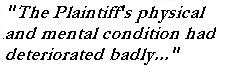
...the plaintiff's physical and mental health had deteriorated badly. She had lost her appetite, was twenty pounds underweight, was unable to sleep properly, and was constantly on the verge of tears. On June 27, she saw her family doctor who advised her to go on sick leave and gave her a note to that effect.

..."I am becoming terrified to come to work, I cannot eat or sleep, I'm on the verge of tears constantly and I'm starting to become convinced it is my fault. I cannot work under these conditions and fear for both my safety as well as my physical and emotional well-being. I am very sorry that this had to come down to this because I feel that I am probably going to be the one to suffer the consequences by being transferred. I do not want to leave Merritt at this point, however, I cannot continue to live and work under these conditions."

...On February 4, 1996, Dr. Carmichael diagnosed the plaintiff as having a major depressive disorder. The plaintiff's weight hovered around 100 lbs. She was not sleeping properly, had difficulty remembering things, and was generally in poor mental and physical health. Dr. Carmichael told the plaintiff to take sick leave, and telephoned the detachment himself to notify her superiors.

...Dr. Carmichael then received an angry phone call from Staff Sergeant Smith, who asked for details of the plaintiff's medical condition, alleged that the plaintiff had manipulated Dr. Carmichael, questioned Dr. Carmichael's ability to do his job, and informed him that the plaintiff might have a drug-dependency problem. The plaintiff believes that Staff Sergeant Smith also reported the drug allegation to RCMP headquarters because headquarters made telephone inquiries with her family doctor, who in turn, notified her.

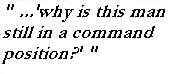
Following that examination, the new divisional representative, Staff Sergeant Howarth, interviewed the plaintiff at her home. On June 24, 1997, Staff Sergeant Howarth sent a report to Chief Superintendent Hrankowski, the officer in charge of administration and personnel for E Division. In his report, Staff Sergeant Howarth acknowledged that his information came from Dr. Carmichael and the plaintiff. He wrote amongst other things: "There is always another side to this BUT if any of this is true, S/Sgt. Smith should not be in the position he is in. I have no reason to doubt Cst. Wilson or Dr. Carmichael." Staff Sergeant Howarth also noted: "Another question that has to be researched is the fact that S/Sgt. Smith may have been investigated for harassment of a female member a few years ago while stationed in the Yukon and the outcome is believed to be founded. If this is true WHY is this man still in a command position?"

The prior episode of harassment to which Staff Sergeant Howarth referred allegedly occurred when the defendant Smith was posted to the Watson Lake detachment between 1986 and 1991.

He was in charge of that detachment and had supervisory authority over Constable Telup, a female First Nations RCMP member. Constable Telup described incidents in which the defendant exhibited intemperate and insensitive behaviour as well as an incident in which he allegedly made improper sexual advances. Constable Telup did not make a complaint at the time, but eventually went on stress leave.

...Inspector Hanniman's detailed report was submitted in evidence before this court. Although it is a slightly edited version, it is Inspector Hanniman's product to which nothing has been added. Based on that report, Chief Superintendent Cameron, the officer in charge of human resources for E Division, notified the plaintiff in writing on September 4, 1998, that the investigation was concluded, that her allegations of harassment had been substantiated, but that no disciplinary action could be taken with respect to Staff Sergeant Smith because he had retired from the RCMP in April 1998.

...Broadly stated, the defendant denied making any derogatory or inappropriate comments about the plaintiff in the presence of detachment personnel. He agreed that the plaintiff's performance as a police officer was of concern and that she was, from time to time, the subject of private discussions between him and Sergeant Angel. Smith denied, however, that these conversations included comments that they would "get her" when she returned to work, that she would pay dearly for her mistakes, that she was screwing the system by taking six months off, or that she had gotten pregnant to screw the force. He admitted discussing the possibility that the plaintiff was afraid of the dark with Sergeant Angel, but says that this was done in private.

... The only explanation that Smith gave when cross-examined about the fact that some of these admitted discussions became common knowledge within the detachment was that the walls in the detachment were very thin.

...However, this evidence must also be considered in context. The RCMP is a paramilitary organization. One of the functions of the supervising non-commissioned officers is to critique the work of their subordinates in an effort to increase their knowledge and skills. The culture in the RCMP was, until comparatively recently, male-oriented, direct, and undiplomatic, while the plaintiff was, on occasion, overly sensitive.

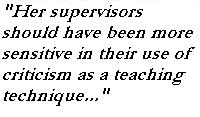
Her supervisors should have been more sensitive in their use of criticism as a teaching technique, and should have dealt with the problem of her repeated absences in a different manner. Although the defendant Smith asserts that he was merely trying to point out to the plaintiff where improvement was needed to assist her in her development as an RCMP officer, the plaintiff cannot be faulted for believing that his comments, like those made in the letter that he had a staff member read over the telephone to her and those contained in the memorandum rejecting her application for a transfer to the highway patrol, went far beyond constructive criticism.

NEGLIGENT INFLICTION OF MENTAL SUFFERING

... A successful claim of negligence must demonstrate that the defendant owed the plaintiff a duty of care, that the defendant breached that duty of care, and that damages or injury resulted from that breach.

The defendant Smith, as the officer in charge of the Merritt detachment and the plaintiff's commanding officer, owed a duty of care to the plaintiff. It was his duty to ensure that she could work in a harassment-free environment, as is required by various anti-harassment policies that the RCMP has in place.

There is no question that Smith breached that duty. The evidence demonstrates that he was prone to angry outbursts, particularly when it pertained to the plaintiff. This was substantiated from a number of sources.... Smith should have known that his intemperate and, at times, unreasonable behaviour would have negative consequences for the members of the detachment generally and the plaintiff in particular.

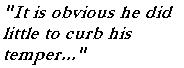
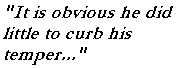
It is obvious that he did little to curb his temper or prevent the rumours that were circulating about the plaintiff, even though he ought to have known, certainly after receiving a copy of the plaintiff's Statement A if not before, that he was causing serious emotional problems for the plaintiff at a time when she was facing significant personal pressures due to her pregnancies. His frequent outbursts and his cutting comments were major causes of the troubled work environment that the plaintiff experienced. It is clear that the defendant Smith violated the RCMP harassment policy, and consequently, breached the standard of care he owed to the plaintiff as a member under his command.

In the circumstances of this case, foreseeability and remoteness are not significant issues. The RCMP established and distributed harassment policies after women were allowed to join the force. All members knew or ought to have known that these policies were meant to forestall harm such as that which occurred here.

Did the defendant's harassment cause or materially contribute to the plaintiff's health problems? The defendants pointed to the fact that the plaintiff had many sources of stress in her life. She had three children within three-and-a-half years.... In other words, defence counsel suggested that it is the plaintiff's personality and the stresses unrelated to her work that is the source of her current problems.

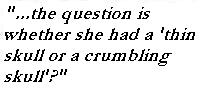
There is merit to this argument. To use a well-known euphemism, the question is whether she had a "thin skull or a crumbling skull?"

There is no doubt that the plaintiff suffers from depression. Dr. Carmichael, in a letter dated August 20, 2003, stated: "Ms. Sulz' s diagnosis according to the DSM-IV criteria has been Major Depressive Disorder, single episode, chronic, with anxiety and irritability features." He went on to say:

Symptoms have included combinations of depressed mood, loss of interest/pleasure in things once enjoyed, low self-esteem, irritability, loss of appetite and weight loss such that at one time hospitalization was considered, significant anxiety, fatigue/loss of energy, strong feelings of guilt, low libido, cognitive impairment (concentration, memory, decision-making), social withdrawal, psychomotor retardation, and persomnia/unrefreshing sleep. Thus, she has not been able to pursue gainful employment since the condition was diagnosed in 1996 due to her condition and its unpredictability. It is clear to me that she can never return to police or related work. 156]

Further on in his letter, Dr. Carmichael states that the "proximal cause of the depression is the long period of work place harassment by the detachment commander at the time, S/Sgt. D. Smith, and by two of his subordinates."

...Although there are many other stresses in the plaintiff''s life, and although she may tend to personalize incidents that others might not, the evidence as a whole shows that the harassment which she experienced in 1994 and 1995 was the proximate cause of her depression, which in turn, ended her career in the RCMP.

The plaintiff has therefore successfully established that the defendant Smith's breach of the duty of care he owed to her caused her serious psychological harm. Although Smith himself is protected from liability for his negligence by s. 21 of the Police Act, the plaintiff has a valid claim for damages against the Provincial Crown based on the principle of vicarious liability.

UPDATE: January, 2007: B.C. Court of Appeal Upholds Sulz $950,000.00 Damages Award

- Garry J. Wise, Toronto

Visit our Employment Law Page: www.wiselaw.net/employment.html

Friday, March 17, 2006

Canadian Spousal Support Advisory Guidelines - Update

I last wrote about the proposed Spousal Support Guidelines in May 2005, to discuss the general features of the new advisory guideline recommendations.

I came across this very interesting summary of how the Courts have been applying the Guidelines in decided cases throughout Canada. As you will note, the Spousal Support Guidelines have had varying degrees of influence, but as at the date of the summary (July 2005), they were increasingly emerging as a starting point for consideration of the quantum and duration of spousal support Orders.

This observation is consistent with our general experience to date in Ontario.

Visit our Family Law Pages: www.wiselaw.net/family.html

Thursday, March 16, 2006

Roll up the Rim and Sue

This today, at CP24 (from my friend Mike Fata)

... In fact, to find the one issue that seems to have transfixed so many, you have to journey down the 401 to Saint-Jerome, Quebec and enter a local Tim Horton’s. That’s where a man who works at a local school bought a coffee, took it with him to work and threw it out in the trash.

It was retrieved by a 10-year-old girl, who asked another student to help her roll up the rim to see if she’d won anything. And as it turns out she had – a Toyota SUV worth almost $30,000. Since then, the drama has deteriorated into an almost embarrassing farce, with three different parties – the man who bought the coffee, the family of the girl who found the cup and the parents of the child who rolled up that rim – all insisting they are the ones who really have claim to the bounty.

Now the lawyer for the coffee buyer is demanding a DNA test to show he’s the real winner – even if he did throw away the winning cup.

The story has become a cause celebre across the country and everyone’s talking about it – when else – during their coffee break. “I think it's only fair to share the prize, I think its unfair not to,” suggests Harry Mohabir as he sips some java at the Eaton Centre. Ida Mancini doesn’t agree. “In all fairness, I think the girl that found the cup, she should keep it,” she insists.

Lawyers, who are the only ones reaping the benefits of the bizarre dispute, admit it’s a tricky area of law. “It's not cut and dried because it is going to depend on a lot of different factors,” contends property lawyer Kelly Moffatt. “The contest sponsors can never really know, no matter how tight their legal rules are, how the contest entrants are gonna respond and what all of those facts are gonna be that are in play.”

In other words, Tim Horton’s is brewing up a lot of publicity without having to do anything. And that’s something money can’t buy. As for settling the dispute, the company notes the person who submits the winning rim is eligible to collect the prize.

But like just about everything els in this twisted case, that decision can be challenged in court. And you can bet given the animosity already shown so far, it probably will be.

Link: http://www.pulse24.com/Business/Top_Story/20060314-002/page.asp


Visit our website: www.wiselaw.net

Tuesday, March 14, 2006

Child Support Guidelines - Changes Ahead in May 2006

On May 1, 2006, the Canadian Child Support Guidelines will be updated with significant amendments.

Among the most important of these changes is that the child support tables have been revised and monthly basic support payments will be increasing.

The amendments will also affect how the Courts determine whether certain kinds of discretionary extraordinary expenses will require contribution by a support payor. In particular, expense claims for primary and secondary education costs and extracurricular activity expenses will be affected. Claims for day-care, medical and post-secondary education costs are not affected by the amendments.

TABLE AMOUNTS TO CHANGE

The monthly "basic support" tables have been updated, and. the required basic support amounts will be increasing as of May 1, 2006.

For example, the monthly child support payable by an Ontario parent of two children will increased as follows:

Income ------New Guidelines------------ Current Guidelines
$50,000 ----------$753.00 -----------------------$700.00
$70,000 ----------$1029.00---------------------- $927.00
$100,000--------- $1404.00--------------------- $1240.00


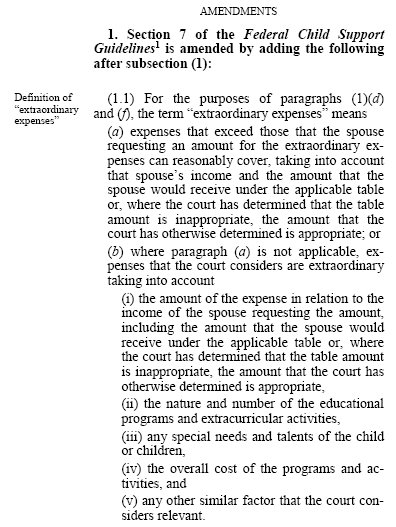
EXTRAORDINARY EXPENSES - Section 7 of the Guidelines

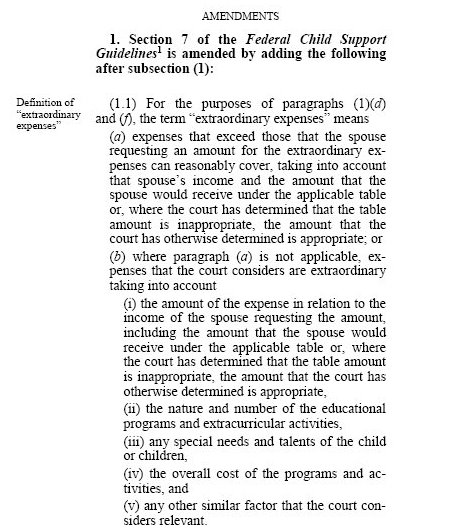
The new version of Section 7 gives Courts much increased flexibility in determining whether certain extraordinary expenses will require additional financial contribution by a support payor.

The new Guidelines will affect claims for contribution by a payor to extraordinary expenses for:


  • primary or secondary school education or for any other educational programs that meet the child's particular needs, and
  • extraordinary expenses for extracurricular activities.
A custodial parent requesting such contribution must demonstrate that the requested extraordinary expense cannot reasonably be covered by the basic support payable.

This "reasonable coverage" requirement may well impose a new threshold or test for determining whether additional contribution to an expense is required.

At the very least, the Courts are to be given a widened discretion by this amendment.

While this may be seen as codifying a discretion that has to some extent already been exercised, it does open up a significant statutory front for resistance by payors to claims for contribution toward the specified extraordinary expenses.

The new Section 7 is reproduced below:


These amendments do not affect the requirement of contribution for day care and child care expenses, medical and dental expenses, or the costs of post secondary education. These expenses will continue to be assessed, taking into account:
  • the necessity of the expense in relation to the child's best interests
  • the reasonableness of the expense in relation to the means of the spouses and those of the child, and
  • the family's spending pattern prior to the separation.
For a full text of the new Guideline tables and amendments, see:
http://canadagazette.gc.ca/partII/2005/20051214/pdf/g2-13925.pdf#page=356


- Garry J. Wise, Toronto
Visit our Ontario Family Law Pages at: www.wiselaw.net/family.html

Wednesday, January 11, 2006

Moon over Maryland


Another silly case...

(Slightly edited from the original report in the Detroit News:)

A Maryland judge has ruled that mooning is a cheeky yet legitimate form of communication. "With hard work, we cracked the case, no buts about it," lawyer James Maxwell said of his legal victory last week.

Last June, exasperated by a feud involving a homeowners association, Raymond McNealy, 44, of Germantown, Md. felt moved to moon his neighbor Nanette Vonfeldt, a Member of the association's board, who was accompanied by her 8-year-old daughter.

McNealy was tried for indecent exposure and found guilty last fall. His Misbegotten moon could have cost him three years in prison and a $1,000 fine.

After an automatic appeal, last week the verdict was reversed.

In ruling that buttocks are never "private parts" to fit the crime of indecent exposure, Circuit Court Judge John Debelius III said, "If exposure of half of the buttock constituted indecent exposure, any woman wearing a thong at the beach at Ocean City would be guilty."


- Garry J. Wise
Visit our Website - www.wiselaw.net

Unborn Baby not a Person - Arizona Car Pool Judge


See this ABC News story on breaking developments in Phoenix, Arizona traffic law.

A very pregnant woman, after being stopped by the police for driving alone in a carpool lane limited to vehicles with more than one passenger, pointed to her very expectant stomach and said something like... "But officer, there are two of us...."

On Tuesday, an Arizona judge ruled that fetuses should not be considered passengers in HOV lanes. On Nov. 8, Ahwatukee, Ariz., resident Candace Dickinson, who was nine months pregnant and driving alone, hoped to break out of Phoenix's heavy rush-hour traffic and moved into an HOV lane. Police pulled her over and wrote a ticket.

Dickinson, 23, fought the ticket, saying that her then-unborn child was her other occupant. She appeared in court Tuesday to state her case, but Municipal Court Judge Dennis Freeman rejected her argument.

The mom-to-be was found guilty and fined $367.00.

One can only hope this case will not attract the attention of Ralph Reed and the pro-Life movement.


- Garry J. Wise


Visit our Website - www.wiselaw.net